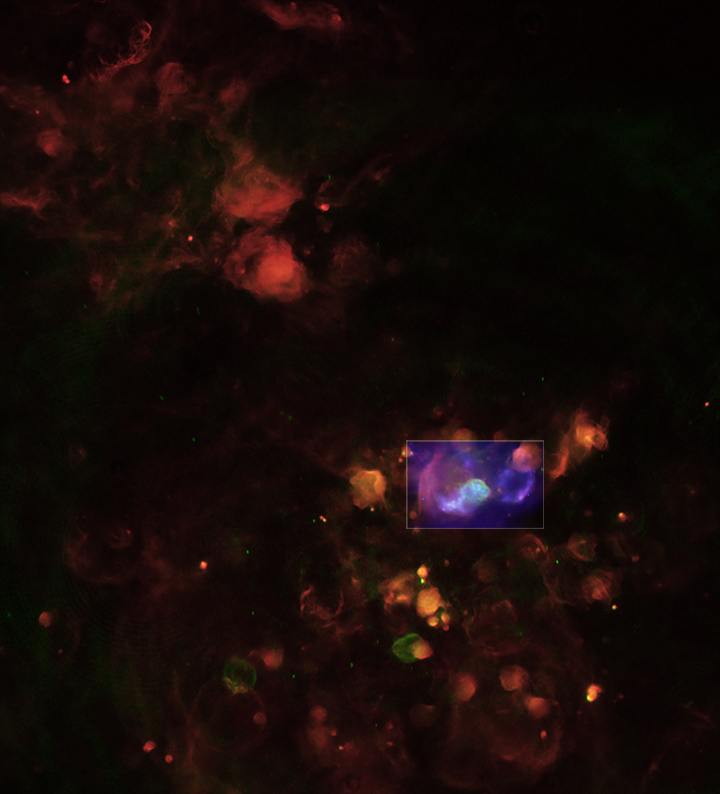
 Credit: X-ray:NASA/CXC/UIUC/R.Williams et al.; Optical: NOAO/CTIO/MCELS coll.; Radio: ATCA/UIUC/R.Williams et al.
Bursting Bubbles
Starbursts, regions of certain galaxies showing enhanced rates of star formation, are identified by large numbers of short-lived massive stars. But what happens when all these stars die and explode? It might look something like the N19 region of the Small Magellanic Cloud. In N19, a deep optical and radio study (shown above) reveals dozens of large, bubble-like structures. Such structures can either be produced by the combined stellar winds of the massive stars associations, or from explosions of those stars. A Chandra X-ray Observatory image of a portion of that region, in blue and purple, shows extended X-ray emission. The X-ray emission suggests the presence of 3 supernovae in this region, and that the stellar bubbles which formed have merged to form a large "superbubble". Such superbubbles are probably common in starburst galaxies, and perhaps in the Milky Way as well.
<
HEA Dictionary ● Archive
● Search HEAPOW
● Other Languages
● HEAPOW on Facebook
● Download all Images
● Education ● HEAD
>
Each week the HEASARC
brings you new, exciting and beautiful images from X-ray and Gamma ray
astronomy. Check back each week and be sure to check out the HEAPOW archive!
Page Author: Dr. Michael F. Corcoran
Last modified Tuesday, 27-Feb-2024 10:06:48 EST