

RXTE Discoveries
RXTE Confirms Long Term Period in Cygnus X-2 - September 1996
Data from the All Sky Monitor (ASM) aboard RXTE has confirmed the detection of a 77.7 day period from the low mass X-ray binary Cygnus X-2. Astronomers Rudy Wijnands, Erik Kuulkers (the Netherlands) and Alan Smale (United States) rushed their announcement to the astronomy community in a International Astronomical Union (IAU) Circular on Aug 16, 1996. The use of the ASM to detect long term variations in X-ray sources is one of its primary missions.
|
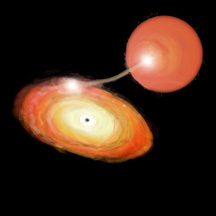
Low mass X-ray binaries, like the artist's impression shown to the right, consist of a low mass star like our sun and a compact object, such as a neutron star or a black hole. In Cygnus X-2, a neutron star and a low mass giant star orbit around each other once every 9.8 days. This is one of the longest orbital periods observed in low mass X-ray binaries. Nevertheless, they are separated by only 6 million miles, less than one tenth the distance from the earth to the sun. Matter is transferred from the normal star to the neutron star, forming a disk of material around the neutron star. X-rays are emitted as the material falls onto the neutron star.
|  |
A longer period of Cyg X-2, not associated with the orbital motion, had been suspected from data collected from other all sky monitors which flew in the past. In the 1970's, Dr. Steve Holt and colleagues used data from the Ariel V satellite, while in 1992 Drs. Alan Smale and James Lochner examined data from the Vela 5B satellite. Candidate long term periods ranged from 45 days to 78 days. However, studies were hampered by the fact that Cyg X-2 also undergoes large intensity variations on the time scale of a few hours.
Wijnands and his colleagues detected the 77.7 period in publicly available data from the ASM collected since mid-February. The low background and favorable sky coverage of the ASM allowed the period to be detected with a confidence of greater than 99%. They also re-examined the data from Vela 5B and Ariel V, and obtained independent confirmation for this period. In addition, data obtained using archival observations from other satellites were consistent with the intensity predicted from this period.
Long term periods in these binary systems are thought to be due to one of two possible causes. In some systems, it is due to regular changes in the rate at which matter flows from the normal star to the neutron star. These changes may be caused by oscillations in the normal star or by instabilities in the disk surrounding the neutron star. In Cyg X-2 and some other systems, however, these long periods are thought to be due to a warp in the disk. The tidal gravitational forces of the two stars causes the disk to precess, which in turn causes occasional blocking of the X-rays being emitted near the neutron star. However, the cause of the warp in the disk remains unknown.
One of the chief missions of RXTE's All Sky Monitor is the search for long term variations in X-ray sources. As in Cyg X-2, these long term variations tell astronomers about the structure of accretion disks or the nature of the stellar companion. Astronomers are looking forward to continued discoveries to be found in the All Sky Monitor data.