
 Credit: NASA/CXC/SAO
Signals from Supernova Survivors?
Star formation takes place at different rates in different places. In some galaxies, star formation is extremely rapid, where dozens or hundreds of stars are produced each year. Such galaxies are called "starburst" galaxies. These galaxies produce large numbers of massive stars. Since massive stars produce complex atoms during their short, brilliant lives, starbursts are chemical factories. Starbursts are also factories of supernovae and compact objects like neutron stars and black holes, which are produced by supernova explosions which mark the death of every star more massive than about eight times the mass of the sun. The nearest and one of the best studied of the class of starburst galaxies is M83, a spiral galaxy about 12 million light years from the Milky Way.
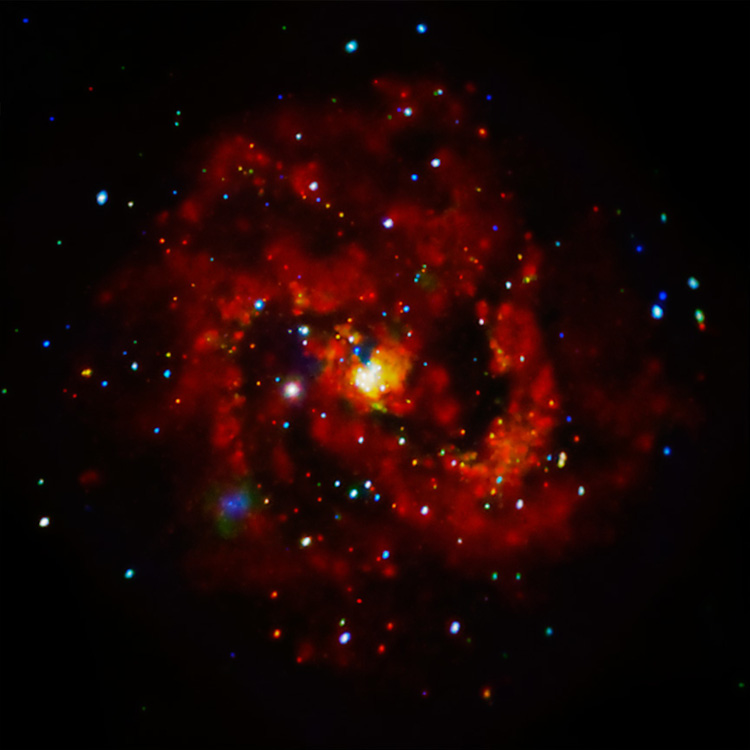
The Chandra X-ray image of M83 is shown above in "true" color, in which color represents the energy of the detected X-ray photon (red for low energy, blue for high energy). This image shows an X-ray bright region at the center of the galaxy, suggesting large numbers of neutron stars which mark the last resting place of the dead stars in M83. Chandra observations of M83 span over 14 years, providing a trove of data on changes in the galaxy's X-ray source population over that time. A new study of Chandra's archive of X-ray observations of M83 found that a population of X-ray emitting supernova remnants showed surprising X-ray variability. Supernova remnants are the ejecta expelled by the tremendous explosions which mark the end of a massive star's life after the star runs out of fuel. Supernovae are so powerful that the ejecta from them create enormous regions of shocked gas hot enough to emit X-rays. But the X-ray emission comes from a large expanding region dozens of lightyears in size, and the emission should slowly fade as the ejecta expands and cools. So the unexpected changes seen in the X-ray emission from M83's supernova remnants was surprising. Scientists believe that the variable X-ray emission probably comes from high-mass X-ray binaries embedded within the supernova remnants. High-mass X-ray binaries are strong X-ray sources in which matter from a normal, high-mass star is swallowed by a compact companion (either a neutron star or black hole), converting gravitational potential energy of the accreted gas into the energy of X-ray radiation. The X-ray variability of these supernova remnants may be the final signals of the compact survivor of the star that exploded.
Published: June 29, 2026
<
HEA Dictionary ● Archive
● Search HEAPOW
● Other Languages
● HEAPOW on Facebook
● Download all Images
● Education ● HEAD
>
Each week the HEASARC
brings you new, exciting and beautiful images from X-ray and Gamma ray
astronomy. Check back each week and be sure to check out the HEAPOW archive!
Page Author: Dr. Michael F. Corcoran
Last modified Monday, 29-Jun-2026 11:46:18 EDT