
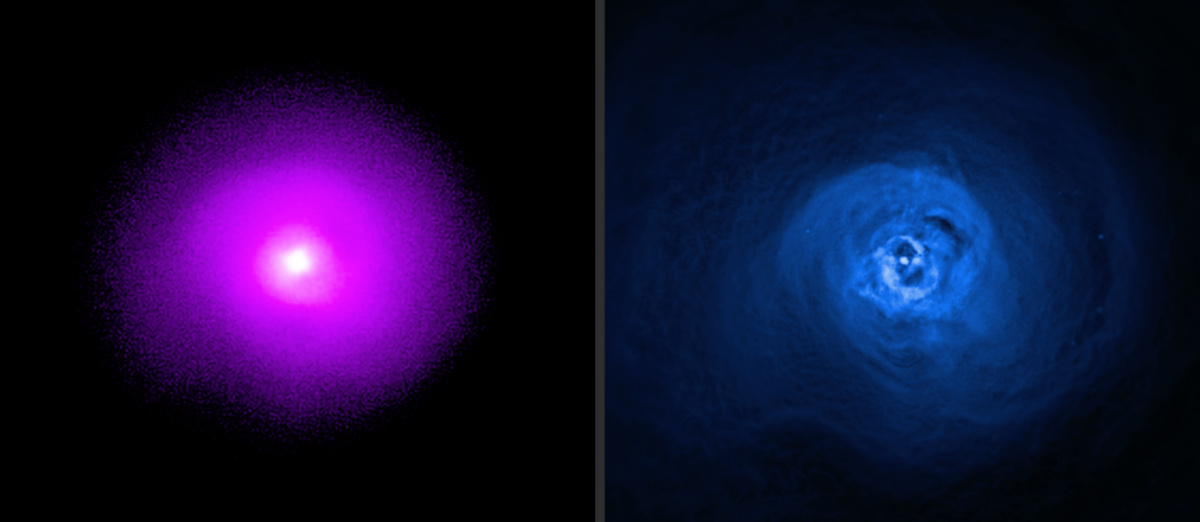
 Credit: X-ray: (Chandra) NASA/CXC/SAO, (IXPE) NASA/MSFC; Image Processing: NASA/CXC/SAO/N. Wolk and K. Arcand
Getting the Slant on an X-ray Jet
Active galaxies produce tremendous amounts of energy from central supermassive black holes. These black holes have masses of millions or even billions of times the mass of the Sun packed into a space smaller than our Solar system. These galaxies are "active" because their central supermassive black holes are swallowing immense amounts of gas (and stars and planets), and as this material spirals down into the deep gravitational well of the black hole, its gravitational potential energy is converted to kinetic energy, heat and radiation. Often active galaxies show powerful, very narrow, fast outflows, or "jets" from the supermassive black hole. These jets can extend for hundreds of thousands of light years from the supermassive black hole, and can play an important role in shaping the environment around the galaxy, feeding material from the galaxy back into intergalactic space.
A prime example of a supermassive black hole jet is the one that originates from an active galaxy known as 3C84, located at the very center of the Perseus Cluster of galaxies, a large hive of individual galaxies, an enormous reservoir of hot gas, all held together by the gravitational pull of the mysterious dark matter in the cluster. While most jets from supermassive black holes are discovered from their low-energy radio emission, some jets are also found to be sources of high energy X-rays. The origin of these X-rays have been a long-standing puzzle to scientists. Now a deep observation of the polarization of the X-rays from 3C84 with NASA's Imaging X-ray Polarimeter Explorer (IXPE), in concert with other NASA high-energy observations from the Chandra X-ray Observatory, NuSTAR and Swift, have, for the first time, determined how the X-rays are produced. The X-ray polarization properties of 3C84 provided by IXPE confirm that the observed X-ray emission is produced when lower energy radiation from the jet collides with the fast moving electrons within the jet. When this happens, some of the energy of the electrons is transferred to the radiation, a process called "up-scattering". This gain in energy converts the low-energy radiation into the high energy X-rays.
Published: March 2, 2026
<
HEA Dictionary ● Archive
● Search HEAPOW
● Other Languages
● HEAPOW on Facebook
● Download all Images
● Education ● HEAD
>
Each week the HEASARC
brings you new, exciting and beautiful images from X-ray and Gamma ray
astronomy. Check back each week and be sure to check out the HEAPOW archive!
Page Author: Dr. Michael F. Corcoran
Last modified Monday, 09-Mar-2026 12:10:56 EDT