
 Credit: NASA's Goddard Space Flight Center, JAXA/NASA, XRISM Collaboration et al. 2026
The Source of the Starburst Blowout
The starburst galaxy Messier 82 is one of the most active star forming galaxies known. The enormous rate of star formation (about 10 times higher than the Milky Way's birthrate of about 7 stars per year) is driven by the gravitational interaction with its neighbor, M81. The tug of gravity as the two galaxies rub elbows causes clouds of gas near the center of M82 to collapse and form stars. The intense star formation activity produces a violent superwind, which blows an enormous quantity of gas and dust, more than 30 times the mass of the Sun, out of the galaxy. What powers this wind has been a long-standing mystery. But new observations with the Resolve spectrometer on the X-ray Imaging and Spectroscopy Mission (or XRISM for short) finally appears to have solved this mystery. The Resolve spectrometer can measure X-rays emitted by distributions of atoms in hot gas at exquisitively high resolution, providing unprecedented measure of the motion of the atoms in the hot gas. Resolve measurements of the emission from the hot, highly-ionized iron, calcium and sulfur atoms in the gas near the nucleus of M82 show that this gas exerts an enormous pressure. For the first time, XRISM shows that this pressure is powerful enough to drive the strong wind from M82.
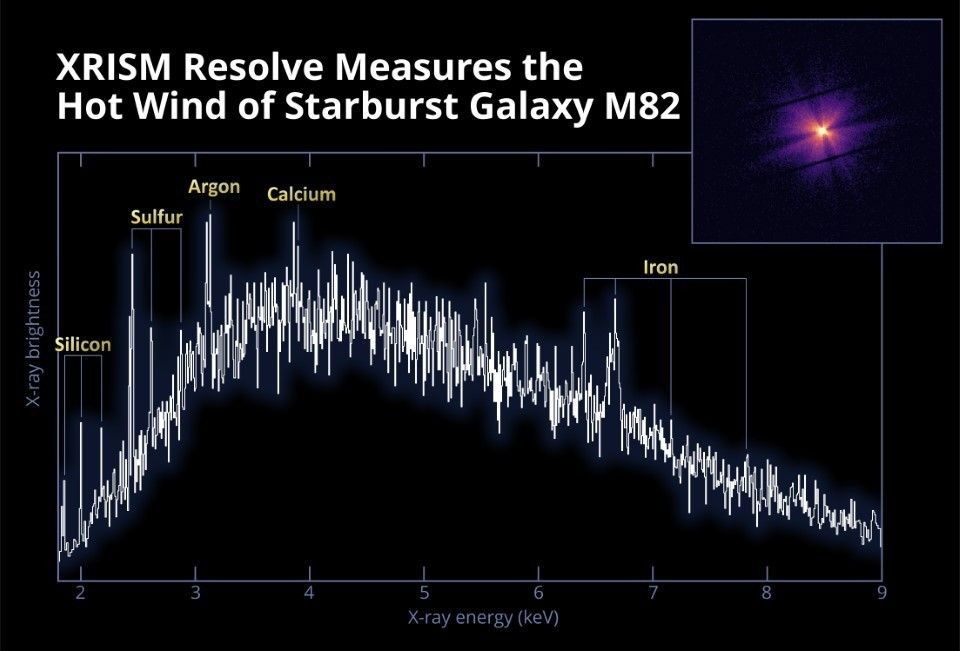
The white graph above shows the high-resolution
Resolve spectrum of M82, characterized by individual emission spikes from atoms of trace elements like iron, calcium and sulfur in the hot gas at the center of M82. XRISM reveals, for example, that the iron atoms move at velocities of about 2 million miles (about 3 million kilometers) per hour, producing high temperatures and pressures. The inset shows the XRISM Xtend image of the central X-ray emission from M82, the source of the superwind. Note that the peculiar shape of the Xtend image is an artifact produced by the XRISM mirrors.
Published: March 30, 2026
<
HEA Dictionary ● Archive
● Search HEAPOW
● Other Languages
● HEAPOW on Facebook
● Download all Images
● Education ● HEAD
>
Each week the HEASARC
brings you new, exciting and beautiful images from X-ray and Gamma ray
astronomy. Check back each week and be sure to check out the HEAPOW archive!
Page Author: Dr. Michael F. Corcoran
Last modified Monday, 06-Apr-2026 11:23:03 EDT