
 Credit: NASA's Goddard Space Flight Center Conceptual Image Laboratory; Rahin et al, 2026, Sci. Adv. 12
Try and Catch the Wind
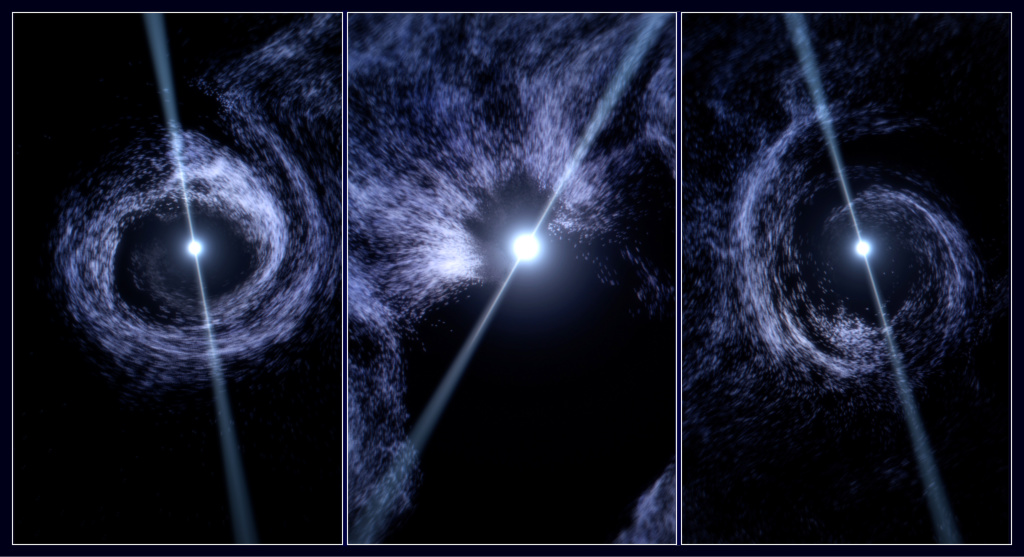
High-mass X-ray binaries are stellar systems containing a normal star with a mass equal to tens of Suns, in orbit around (or orbited by) a neutron star or black hole. The normal stars in these systems have strong stellar winds powered by the star's intense ultraviolet radiation. X-rays are produced by the accretion of some portion of this wind by the strong gravitational field of the compact companion. Although this process has been theorized for decades, it has never been directly observed - until now. Recent observations of a high-mass binary system called BP Cru by the Resolve spectrometer on the JAXA/NASA XRISM X-ray space observatory have provided our first direct look at how the accretion process works. BP Cru, also known as the X-ray source GX 301-2, consists of a slowly-rotating, highly magnetized X-ray neutron-star (a "pulsar"), orbiting a hot, 40 solar mass "hypergiant" star called Wray 977. The pulsar is embedded in the wind of Wray 977 and shows X-ray flares when the hypergiant and the pulsar are closest together. Observations by the Resolve spectrometer during one of these X-ray flares revealed fingerprints in the X-ray spectrum produced by absorption of X-rays by highly ionized iron atoms. This strongly suggested that the absorbing material was very close to the X-ray emitting pulsar. The Resolve spectra also showed that this material was moving towards the pulsar, strong evidence of the direct accretion of a stream of stellar wind material by the pulsar as it moves through the stellar wind stream when the two stars are close. The image above shows an artist's conception of the accretion of stellar wind by the pulsar (the white point in the images, shown with two beams of charged subatomic particles emanating from the pulsar's magnetic poles). On the left, the accreting material forms a temporary disk around the pulsar. In the middle, the disk of wind material is disrupted and falls onto the pulsar, producing a strong outpouring of X-rays. On the right, the accreting wind material again forms a swirling disk of matter as the pulsar leaves the stream. The XRISM/Resolve observations provide a ground-breaking case study of how material is accreted by neutron stars, and reveal the how accretion is shaped by the strong gravitational and magnetic fields of the neutron star.
Published: September 28, 2026
<
HEA Dictionary ● Archive
● Search HEAPOW
● Other Languages
● HEAPOW on Facebook
● Download all Images
● Education ● HEAD
>
Each week the HEASARC
brings you new, exciting and beautiful images from X-ray and Gamma ray
astronomy. Check back each week and be sure to check out the HEAPOW archive!
Page Author: Dr. Michael F. Corcoran
Last modified Monday, 05-Oct-2026 10:16:12 EDT