
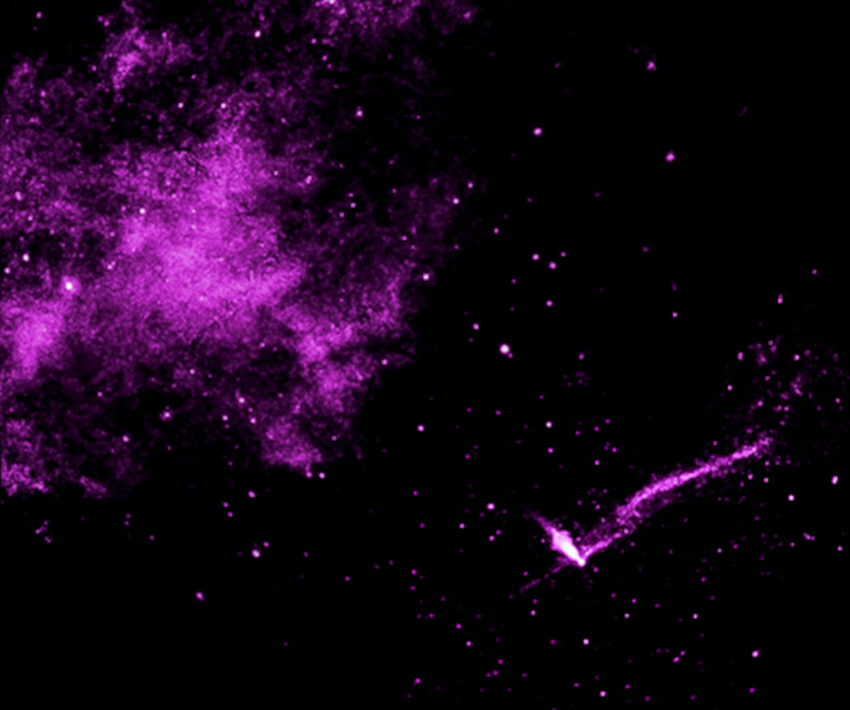
 Credit: X-ray: Chandra: NASA/CXC/Stanford Univ./J. Dinsmore et al.; IXPE: NASA/MSFC/J. Dinsmore et al.; Image processing: NASA/CXC/SAO/L. Frattare
Neutron Star Cannon
Pulsars are rapidly rotating, highly magnetized neutron stars that go flash in the night. These incredibly dense objects (one teaspoon of a neutron star would weigh more than Mount Everest) are the dead, collapsed cores of stars which started out with more than 10 times the sun's mass and which ended in a tremendous supernova explosion. They have incredibly strong magnetic fields, and produce a wide variety of radiation, especially radio waves, visible light, X-rays and even gamma rays in a narrow beam along the magnetic axis. As the pulsar rotates, this emission swings through space like a lighthouse beam, and so can serve as a navigation aid for distant spacefarers. The supernova explosion also produces a supernova remnant, an initially hot cloud of fast-moving gas produced from the outer layers of the star ejected during the supernova explosion. Since both the supernova remnant and the pulsar are produced by the supernova explosion, usually the pulsar is located near the center of the supernova remnant. An unusual case is PSR J1101-6101, sometimes called the "lighthouse pulsar".
The image above shows a false-color X-ray image from NASA's Chandra X-ray Observatory of the area of the sky around PSR J1101-6101 (in purple and white). The pulsar itself is located at the lower tip of a concentrated, brilliant whitish-blue elongated X-ray emitting region in the lower right of the image. It's surrounded by a "pulsar wind nebula", a wake produced as the pulsar moves through the interstellar medium. The pulsar also shows a narrow jet of relativistic particles flowing outward along the magnetic axis of the pulsar's strong magnetic field, whose strength was recently studied by NASA's IXPE X-ray space observatory. The purple cloud in the upper left is the hot gas from the supernova remnant which forms a large extended X-ray emitting cloud. Somehow, it appears that, during the supernova explosion, the pulsar was shot out of the supernova remnant like a city-sized cannonball out of a cannon.
Published: July 27, 2026
<
HEA Dictionary ● Archive
● Search HEAPOW
● Other Languages
● HEAPOW on Facebook
● Download all Images
● Education ● HEAD
>
Each week the HEASARC
brings you new, exciting and beautiful images from X-ray and Gamma ray
astronomy. Check back each week and be sure to check out the HEAPOW archive!
Page Author: Dr. Michael F. Corcoran
Last modified Monday, 03-Aug-2026 14:57:38 EDT