
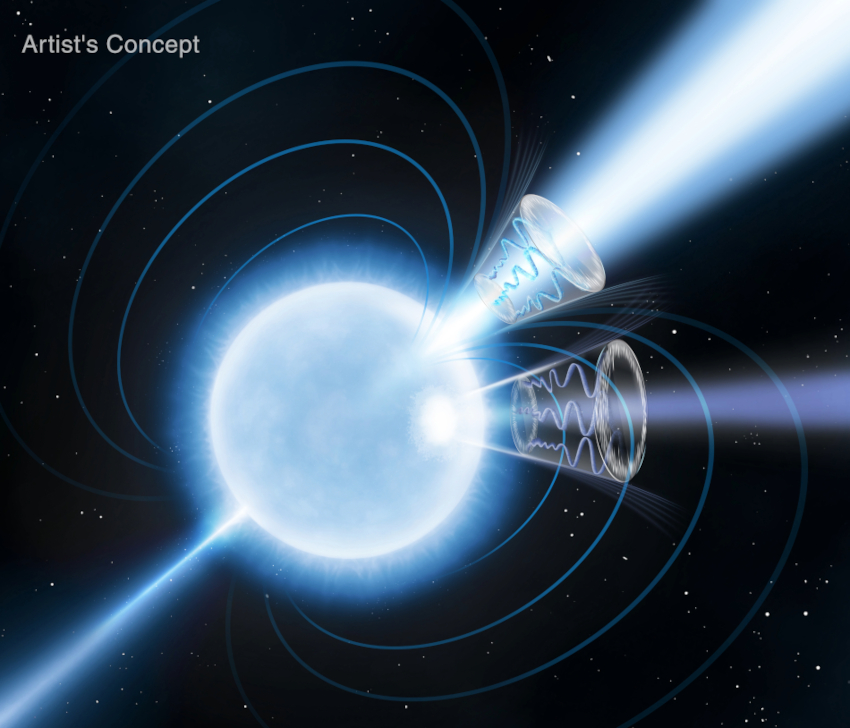
 Credit: NASA/Pablo Garcia
Organizing Empty Space
Neutron stars are the compressed remnants left behind after some massive stars run out of nuclear fuel and collapse, squashing the mass of the sun or more down to the a sphere with a diameter of a small city. Neutron stars are so dense a teaspoonful of neutron star material would be more massive than the entire population of earth. (Interestingly, the nuclei of the atoms that make up teaspoons and people have about the same density as a neutron star). Many neutron stars have exceptionally strong magnetic fields, and a subset of neutron stars, called magnetars, have magnetic fields that are about a thousand times stronger than the typical neutron star. Magnetic fields this strong can rip apart the molecular bonds that hold your body together from a distance of 1000 kilometers.
The enormously strong magnetic fields produced by magnetars can also change the very nature of space itself. This phenomenon, known as "vacuum birefringence", predicts that an extremely strong magnetic field can alter the way electromagnetic waves traverse empty space, effectively causing empty space to act like a polarizing filter. Now a coordinated study of a particular magnetar known to astronomers as 1E 1547.0-5408 seems to have confirmed this prediction. 1E 1547.0-5408 is a magnetar with rotates about once every two seconds, and this rotation produces pulses of both X-ray and radio radiation originating from different hot spots on the surface of the magnetar. Observations by NASA's Imaging X-ray Polarimeter Explorer (IXPE), NASA's Neutron Star Interior Composition Explorer (NICER), along with radio observations by the Parkes/Murriyang radio telescope (operated by Australia's national science agency, the Commonwealth Scientific and Industrial Research Organisation, CSIRO) revealed that the radio and X-ray waves emitted by the magnetar showed an unusually high degree of polarization, meaning that a large fraction of the electromagnetic waves tend to oscillate in a preferred plane.
The image above shows an artistic representation of 1E 1547.0-5408; blue curves represent the magnetic field lines emanating from the north and south magnetic poles of the magnetar. Individual radio and X-ray hot spots and the emission they produce are depicted as cones: the radio emitting cone is directed along the magnetic pole, while X-ray emitting cone is offset from the radio emission. Combined X-ray and radio polarization observations of magnetars provide a unique tool to understanding the basic quantum nature of empty space.
Published: November 2, 2026
<
HEA Dictionary ● Archive
● Search HEAPOW
● Other Languages
● HEAPOW on Facebook
● Download all Images
● Education ● HEAD
>
Each week the HEASARC
brings you new, exciting and beautiful images from X-ray and Gamma ray
astronomy. Check back each week and be sure to check out the HEAPOW archive!
Page Author: Dr. Michael F. Corcoran
Last modified Monday, 09-Nov-2026 14:17:44 EST