
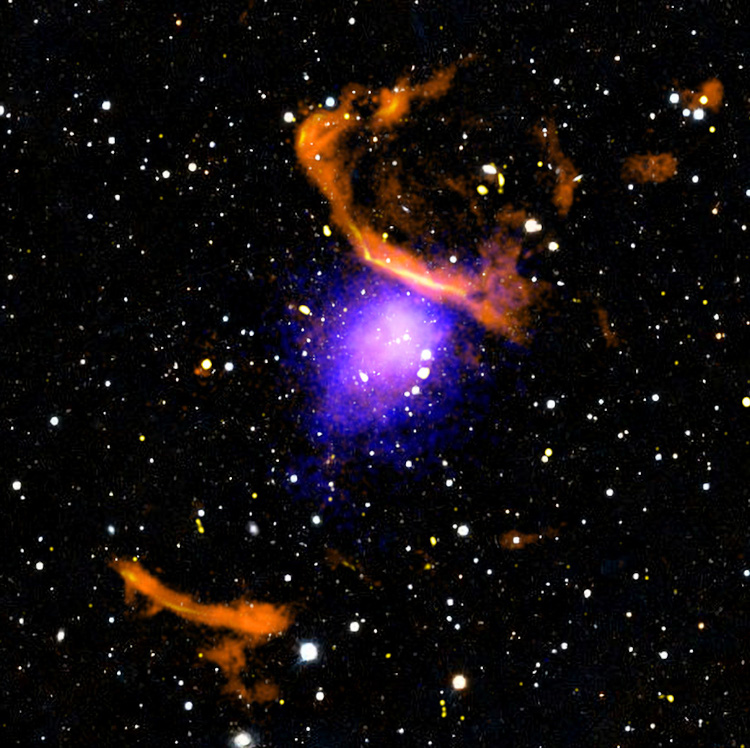
 Credit: X-ray: NASA/CXC/SAO/K. Rajpurohit et al.; Optical: PanSTARRS; Radio: SARAO/MeerKAT; Image processing: NASA/CXC/SAO/N. Wolk
Giant Swarm
The fundamental building blocks of the cosmic web are not stars, or even galaxies, but enormous clusters of galaxies. Galaxy clusters form near enormous knots of dark matter, the strange stuff that holds the material Universe together (or at least, tries to). The gravity of these dark matter knots pulls together an enormous amount of "normal" matter (i.e. matter we can detect through the electromagnetic radiation it emits), which eventually forms bright galaxies and stars. Galaxy clusters typically contain hundred or thousands of individual galaxies, all swirling about in the cluster's combined gravity, and sometimes colliding. The image above shows a galaxy cluster called PLCK G287.0+32.9 in optical, radio and X-ray light. The X-ray emission, from the Chandra X-ray Observatory, is shown by the large purple & blue blob at the center of the false-color image. The amount of normal mass in this hot plasma is about 3 times more than the combined mass of stars in the cluster galaxies. At the top and bottom edges of the X-ray emission are strong shocks where cosmic rays are accelerated to enormous speeds. These shocks are best seen in the radio emission (obtained by the MEERKAT radio telescope), shown in orange and yellow in the image above. This entire structure spans about 20 million lightyears, making it the largesst such swarm of energetic particles ever seen around a galaxy cluster.
Published: June 16, 2025
<
HEA Dictionary ● Archive
● Search HEAPOW
● Other Languages
● HEAPOW on Facebook
● Download all Images
● Education ● HEAD
>
Each week the HEASARC
brings you new, exciting and beautiful images from X-ray and Gamma ray
astronomy. Check back each week and be sure to check out the HEAPOW archive!
Page Author: Dr. Michael F. Corcoran
Last modified Monday, 23-Jun-2025 15:59:08 EDT