
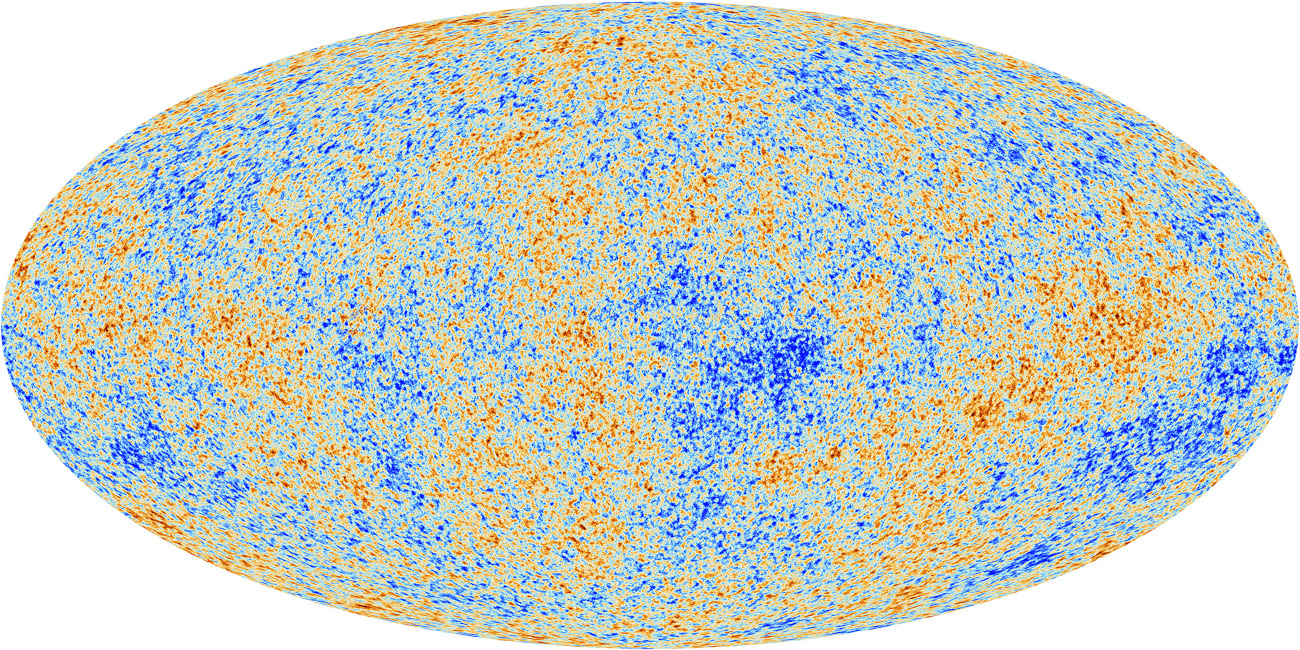
 Credit: ESA/Planck Collaboration
Cosmic Background Bumps in the Night
A fundamental tenet which guides the study of the origin and evolution of the Universe, is that, on large scales, the Universe is isotropic, the same in any direction you care to look. It's difficult to imagine a reason why this wouldn't be the case - why would any particular direction in the Universe be special? And the temperature of the universe appears very nearly isotropic, according to maps of the radiation left over from the Big Bang that created the Universe. This radiation, traveling through space at the speed of light for more than thirteen billion years, can be detected as a universal microwave glow that surrounds us. It's been studied by by NASA's COBE, and WMAP satellites, and ESA's Planck mission. But while the temperature of the Universe is extremely uniform, there are tiny but incredible important fluctuations in temperature from place to place which eventually evolve into the entirety of the material Universe that we see around us: galaxies, stars, planets and humans. The image above is a high-resolution temperature map of the cosmic microwave background radiation, this remnant radiation from the Big Bang, based on the legacy map from all the data obtained by ESA's Planck satellite observatory (which operated from 2009 to 2013). The distribution of red and blue spots in these maps, corresponding to slightly hotter or slotter cooler bits of the Universe, reveals the shape of the Universe, how the Universe has expanded since the Big Bang, and the unexpected importance of Dark Matter, Dark Energy and cosmic inflation in that evolution.
Published: April 27, 2026
<
HEA Dictionary ● Archive
● Search HEAPOW
● Other Languages
● HEAPOW on Facebook
● Download all Images
● Education ● HEAD
>
Each week the HEASARC
brings you new, exciting and beautiful images from X-ray and Gamma ray
astronomy. Check back each week and be sure to check out the HEAPOW archive!
Page Author: Dr. Michael F. Corcoran
Last modified Monday, 04-May-2026 12:58:37 EDT