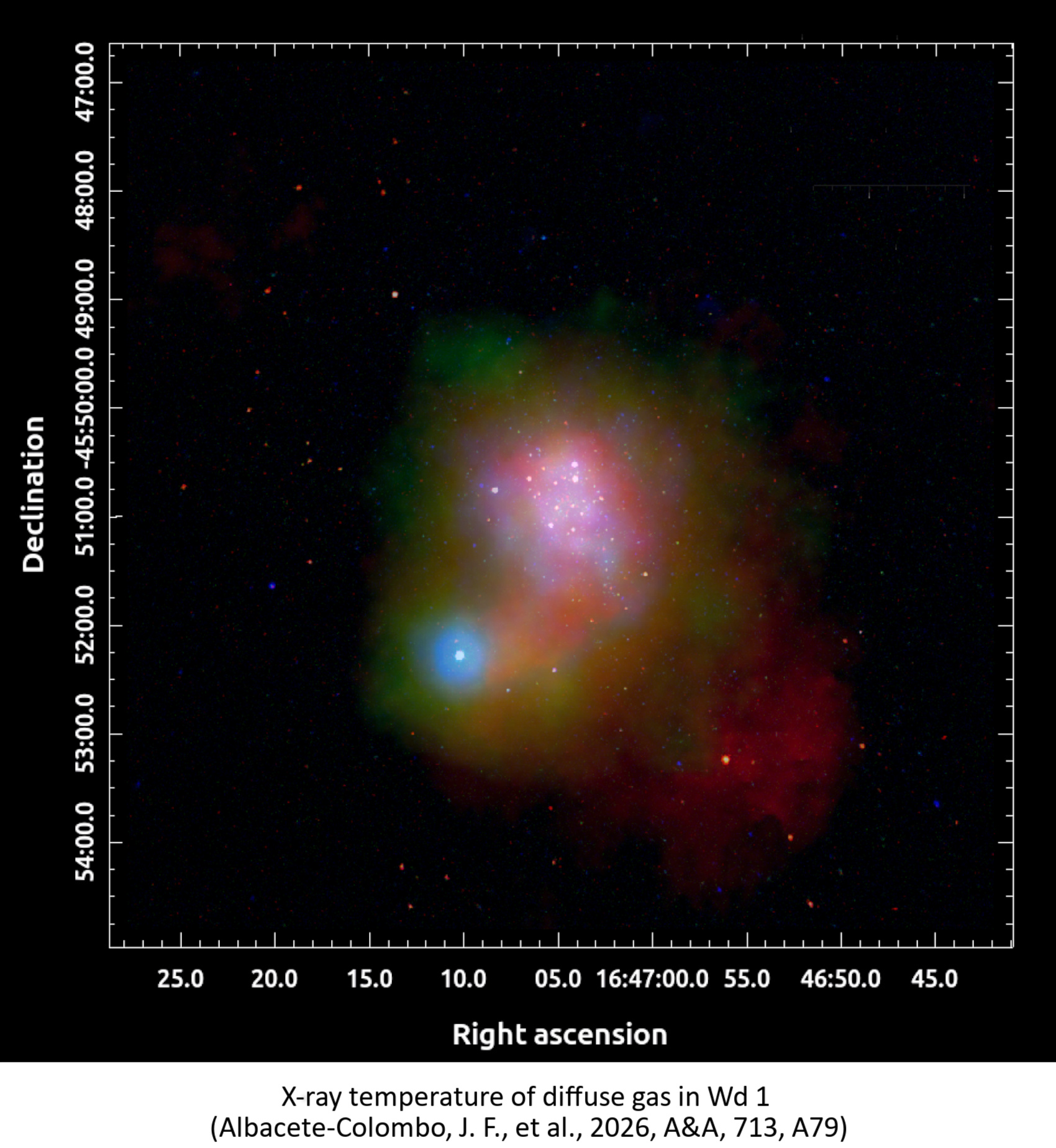
 Credit: Albacete-Colombo, J. F., et al., 2026, A&A, 713, A79
Widespread Shocks in Wd 1
Stars, especially massive stars, tend to form together from large cold interstellar clouds of gas and dust. An extreme example of this is the star cluster Westerlund 1 (Wd 1). Wd 1 is the only supermassive star cluster within 15000 lightyears of the Sun. It contains more than 100,000 stars, from tiny stars about a tenth the mass of the Sun to powerful giants with masses of more than 30 Suns. The massive stars in the cluster blast the surrounding region of the Milky Way's disk with powerful UV radiation. The UV radiation from the stars also creates powerful stellar winds which blow from the surface of the stars into space. These stellar winds pack quite a punch. Each second, these massive winds blow about an earth's mass of stellar material into space, at speeds of millions of miles per hour. As these winds move outward they bulldoze the surrounding region of the Galaxy, producing high energy shocks which produce hot, X-ray emitting gas. The image above is shows a Chandra X-ray Observatory X-ray image of the the distribution of this hot gas around Wd 1, after painstaking correction for the contamination of the X-ray emission from the stars themselves. The X-ray emission surrounds the cluster and has a characteristic size of a few lightyears in extent. Different colors represent different X-ray energies: red represents low-energy X-ray emission from gas at tens of millions of degrees; blue represents high-energy X-ray emission from gas at temperatures of tens of millions of degrees. Somewhat surprisingly, the combined power in Wd 1's diffuse emission is only about 5 times the total power of the Sun over its entire energy band. This result suggests that the cluster wind has carved out a large, low-density cavity in the Galaxy, reducing the overall amount of material to be shocked by the stellar winds.
Published: September 14, 2026
<
HEA Dictionary ● Archive
● Search HEAPOW
● Other Languages
● HEAPOW on Facebook
● Download all Images
● Education ● HEAD
>
Each week the HEASARC
brings you new, exciting and beautiful images from X-ray and Gamma ray
astronomy. Check back each week and be sure to check out the HEAPOW archive!
Page Author: Dr. Michael F. Corcoran
Last modified Monday, 21-Sep-2026 16:05:59 EDT