
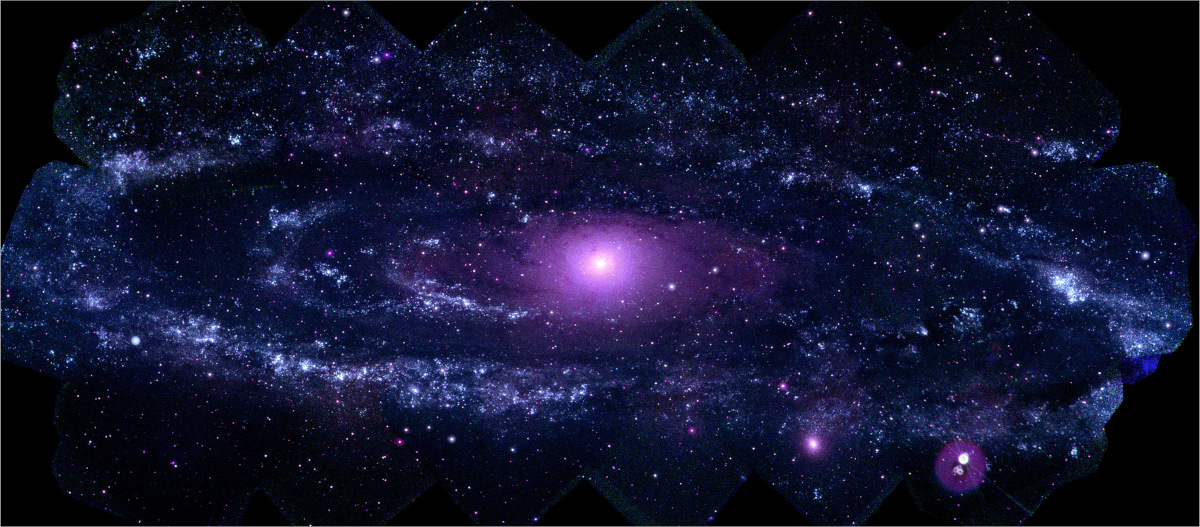
 Credit: NASA; Neil Gehrels Swift observatory
Blacklight Andromeda
Our nearest spiral galaxy neighbor, the Andromeda galaxy (also known as M31) was first recognized as an external galaxy comparable to our own Milky Way by Edwin Hubble in 1925, setlling the "Great Debate" about its nature, and the scale of the cosmos, once and for all. At a distance of about 2.5 million lightyears, and a diameter in excess of 150,000 lightyears, M31 is bright enough to be visible to the unaided eye. M31 provides an excellent example for us to study the shape, dynamics and mass distribution (of both normal and dark matter). In many ways M31 is easier to study than our own Milky Way, since its distance lends perspective. It also lends itself to study in different parts of the electromagnetic spectrum. These types of multi-wavelength studies are important to develop a complete picture of how galaxies behave, since different EM wavebands shed light on different galactic processes. The image above is an image of Andromeda in the ultraviolet, taken by NASA's Neil Gehrels Swift Observatory. Ultraviolet images are important to study where the most massive and hottest (and youngest) stars are located. This image is a mosaic of 330 separate images obtained by Swift's UV/Optical Telescope between May 25 and July 26, 2008, with a combined exposure of more than a day. This UV image shows that most of the hottest, youngest stars are located in the spiral arms, sites of still-active star formation.
Published: April 21, 2025
<
HEA Dictionary ● Archive
● Search HEAPOW
● Other Languages
● HEAPOW on Facebook
● Download all Images
● Education ● HEAD
>
Each week the HEASARC
brings you new, exciting and beautiful images from X-ray and Gamma ray
astronomy. Check back each week and be sure to check out the HEAPOW archive!
Page Author: Dr. Michael F. Corcoran
Last modified Monday, 28-Apr-2025 11:47:16 EDT