
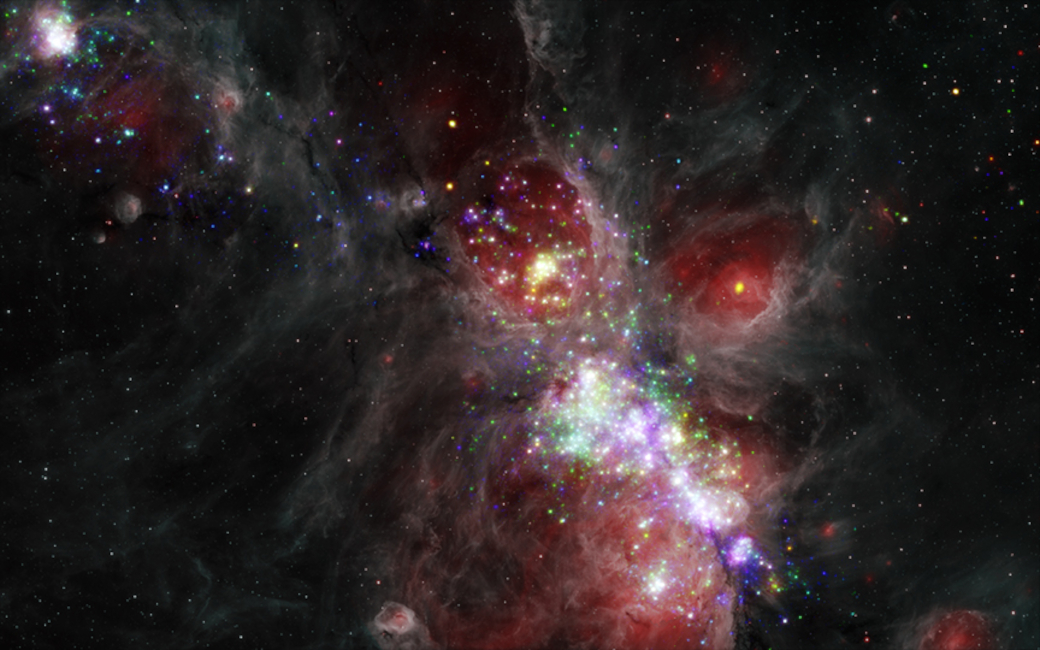
 Credit: X-ray: NASA/SAO/CXC; Infrared: NASA/JPL/CalTech/Spitzer; Image Processing: NASA/CXC/SAO/J. Schmidt
Held in the Cat's Paw
Stars are born within large, massive, dense clouds of gas and dust. The seeds of stars are localized regions in the cloud which, for some random reason, have slightly higher density. Gravity pulls more material into these dense regions, which grow denser and denser and hotter and hotter. There are complications to this simple picture (due magnetic fields, cloud spin, composition and other factors), so the exact process of stellar birth is hard to predict theoretically. And the details of star formation are frustratingly obscured from the gaze of curious astronomers by the thick curtain of dust and gas in the cloud itself. But, when they're old enough, stars themselves pull this curtain aside and make themselves known. Stars do this by shaping large cavities in their natal clouds through the combined actions of strong, powerful stellar winds and supernova explosions. These "superbubbles" give a revealing peak at the baby stars in the stellar nursery. A beautiful example of this is shown above is the NGC 6334 nebula, the so-called "Cat's Paw" nebula shown in the image above. This image is a composite infrared image from the Spitzer Space Telescope and an X-ray image from the Chandra X-ray Observatory. The Spitzer image is dominated by emission from the cool dust in the nebula, along with dark dusty clouds threading the nebula. The X-ray image from Chandra shows that, behind this veil of gas and dust, young stars can be seen by the X-ray emission they produce, shown as red, orange, green, and purple dots in the false-color image. X-rays are driven by the violent activity produced by the strong magnetic fields of the young stars, or by the collisions between the fast-moving stellar winds from the more massive and lumninous stars in the Cat's Paw. These X-rays are vital to help astronomers trace the hidden star formation history in this nebula, and others like it.
Published: December 1, 2025
<
HEA Dictionary ● Archive
● Search HEAPOW
● Other Languages
● HEAPOW on Facebook
● Download all Images
● Education ● HEAD
>
Each week the HEASARC
brings you new, exciting and beautiful images from X-ray and Gamma ray
astronomy. Check back each week and be sure to check out the HEAPOW archive!
Page Author: Dr. Michael F. Corcoran
Last modified Monday, 08-Dec-2025 12:17:59 EST