


The Farthest Visible Reaches of Space
About the Image
Current observations suggest that the Universe is about 13.7 billion years old. We know that light takes time to travel, so that if we observe an object that is 13 billion light years away, then that light has been traveling towards us for 13 billion years. Essentially, we are seeing that object as it appeared 13 billion years ago.
With every year that passes, our newest technology enables us to see further and further back.
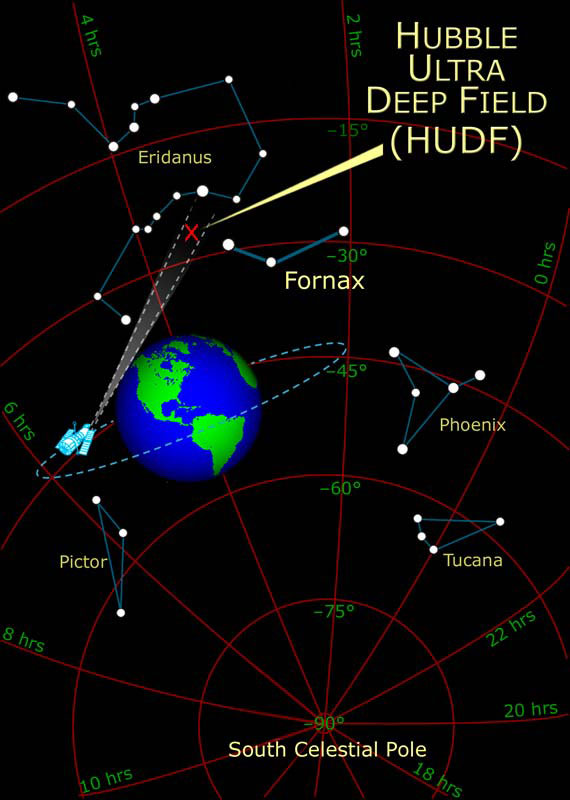
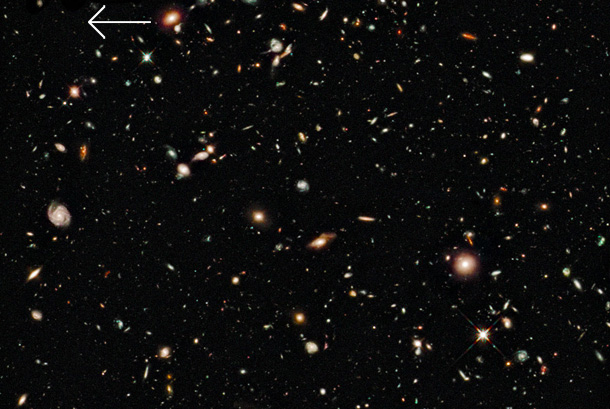
The image used for this stop on our journey is the Hubble Ultra Deep Field (UDF). The UDF is one of the deepest views of the visible universe to date; certainly it was the deepest when it was originally created in in 2003-2004. There are approximately 10,000 galaxies in this view, which is a sort of "core sample" of a very narrow patch of sky near the constellation Fornax. The smallest, reddest galaxies in the image, of which there are about 100, are among the most distant known objects!
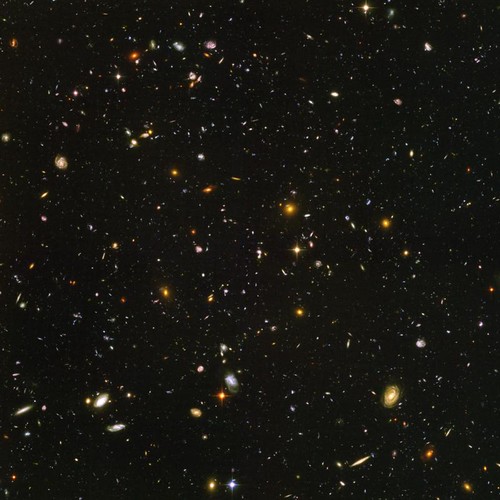
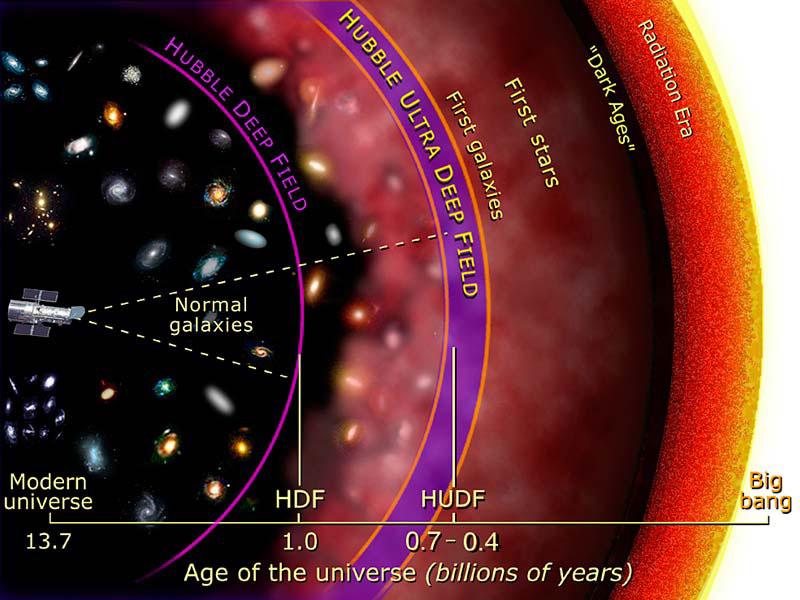
The UDF looks back approximately 13 billion years (approximately between 400 and 800 million years after the Big Bang). Galaxies that existed in that time period would be very young and very different in structure and appearance than the grand spirals we see nearby today.
What is the Farthest Known Object From Earth?
Update 02/03/16: Here are the newest candidates (as of September and May 2015 respectively) for farthest galaxy yet detected. EGS8p7 at more than 13.2 billion light years away, and EGS-zs8-1 at 13.1 billion light years away.
In December of 2012, astronomers announced a Hubble Space Telescope discovery of seven primitive galaxies located over 13 billion light years away from us. The results are from survey of the same patch of sky known as the Ultra Deep Field (UDF). This survey, called UDF12, used Hubble's Wide Field Camera 3 to peer deeper into space in near-infrared light than any previous Hubble observation.
Why infrared? Because the Universe is expanding; therefore the farther back we look, the faster objects are moving away from us, which shifts their light towards the red. Redshift means that light that is emitted as ultraviolet or visible light is shifted more and more to redder wavelengths.
The extreme distance of these newly discovered galaxies means their light has been traveling to us for more than 13 billion years, from a time when the Universe was less than 4% of its current age.
Their discovery, which you can read more about in the NASA feature is exciting because it might give us an idea of how abundant galaxies were close to the era when astronomers think galaxies first started forming. (Phil Plait has a good column about this discovery too.)
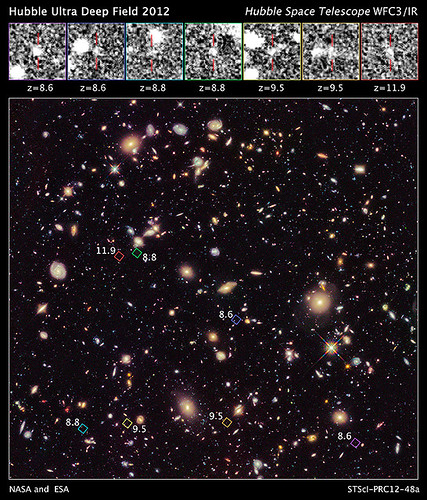
As of this writing it seems that one of the galaxies in this recent Hubble discovery may be a distance record breaker - it was observed 380 million years after the Big Bang, with a redshift of 11.9. This means the light from this galaxy (pictured below) left 13.3+ billion light years ago.
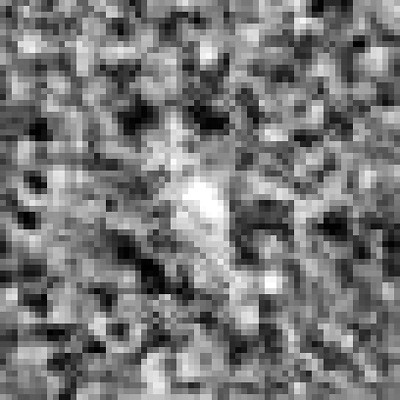
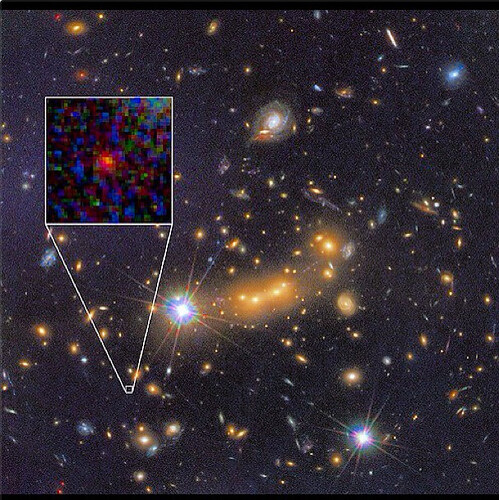
Just under a month ago, the current candidate was this object: a young galaxy called MACS0647-JD. It's only a tiny fraction of the size of our Milky Way - and was observed at 420 million years after the Big Bang, when the universe was 3 percent of its present age of 13.7 billion years. To spot this galaxy, astronomers used the powerful gravity from the massive galaxy cluster MACS J0647+7015 to magnify the light from the distant galaxy; this effect is called gravitational lensing.
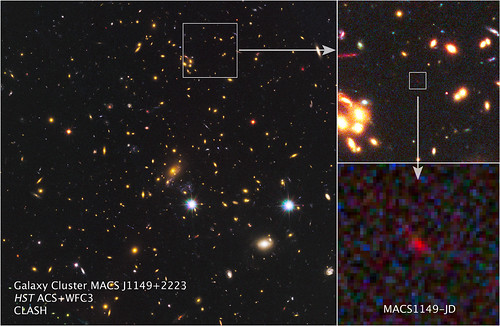
Earlier in 2012, with the combined power of NASA's Spitzer and Hubble Space Telescopes, as well as the use of gravitational lensing, a team of astronomers spotted what might then have been the most distant galaxy ever seen. Light from this young galaxy, MACS1149-JD, was emitted when our 13.7-billion-year-old universe was just 500 million years old.
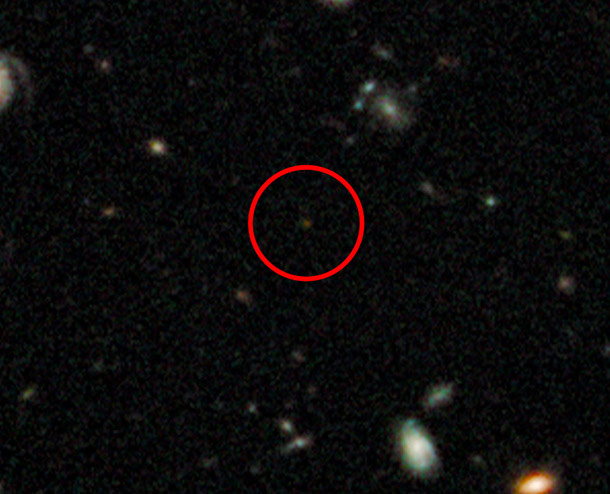
In 2010, a candidate for most distant galaxy was found in the Hubble Ultra Deep Field. UDFy-38135539 is thought to be 13.1 billion light years away. There is more information in this article on Phil Plait's blog. I've used his labeled images:
The objects in the Hubble Ultra Deep Field may well be the farthest known objects, but there are other contenders.
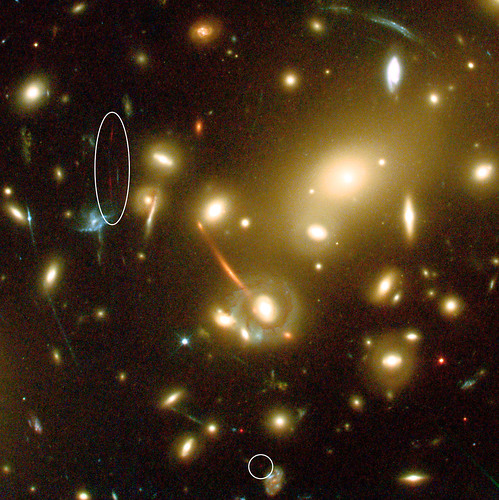
They include a galaxy called Abell 1835 IR1916, which was discovered in 2004, by astronomers from the European Southern Observatory using a near-infrared instrument on the Very Large Telescope. The object is visible to us because of gravitational lensing by the galaxy cluster Abell 1835, which is between this object and us. This galaxy is thought to be about 13.2 billion light years away, which means it would date to about 500 million years after the Big Bang. Note though, that this find has not been verified by other instruments - the Spitzer Space Telescope tried in 2006 without success.
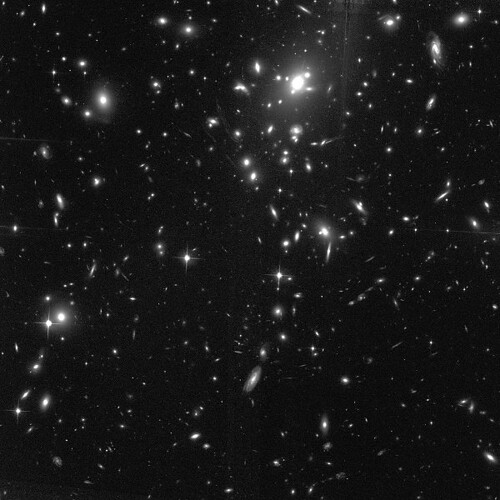
Also in 2004, a team using both the Hubble Space Telescope and the Keck Observatory discovered a galaxy that is believed to be about 13 billion years away from us. It was found when observing the galaxy cluster Abell 2218. The light from the distant galaxy was visible because of gravitational lensing. The very distant object is the one circled. For more information, check out this press release.
Then there's the infrared James Webb Space Telescope. If you recall, Hubble has near infrared capability, but not mid-infrared, and for objects with very high redshifts, to see these most distant of objects would require a powerful telescope with mid-infrared capability. JWST will be able to see back to the first luminous objects to be born after the Big Bang.
In fact, one of JWST objectives is to look even further back, to just 200 million years after the Big Bang. One model of galaxy evolution has the first galaxies forming then and we need JWST to test this theoretical prediction!
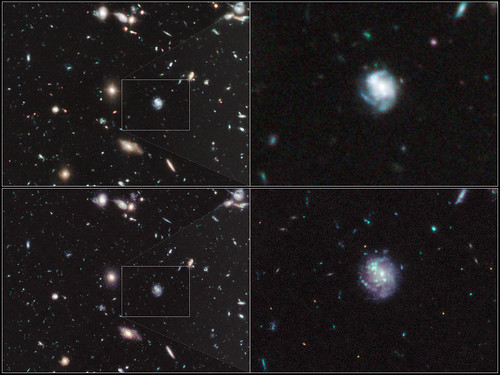
(Note: JWST will be able to see these first galaxies without the aid of gravitational lensing; gravitational lensing might allow us to see them better, but would not necessarily let us see further back in time.)
Distance Information
Some of the most newly detected objects may be over 13 billion light years away, as derived from a standard model of the Universe. However, a powerful new generation of telescopes, like the James Webb Space Telescope, will be needed to confirm the suspected distances of these objects.
When 13 billion light years is translated into kilometers, there are a staggering number of zeros - it comes out to approximately 123,000,000,000,000,000,000,000 km.
As time progresses, so will our ability to see futher and further away - giving us insight on the very beginnings of the Universe's existence!
How do We Calculate Distances of This Magnitude?
At these distances, objects' redshifts are used, with and extension of Hubble's Law to the distant Universe. Here, we have to know the history of how rapidly the universe was expanding at each moment in time. This can be calculated from the amount of normal and dark matter and of dark energy. Try Prof. Wright's Javascript cosmology calculator at:
http://www.astro.ucla.edu/~wright/CosmoCalc.html
For more information on Hubble's Law, please read the section on finding distances to the Nearest Superclusters.
Why Are These Distances Important To Astronomers?
Scientists have estimated the age of the Universe to be 13.73 billion years old (with an uncertainty of about 120 million years). When we observe an object that is 13 billion light years away, we are essentially observing it as it was 13 billion years ago, when the Universe was young. Being able to see and thus hopefully understand the early Universe is important to understanding how it was formed. If we see back far enough, perhaps we will catch a glimpse of the first galaxies as they were just forming. Perhaps we will someday be able to see the first starts forming. Could we see even further back than that? Only time (and technology) will tell!
Travel Time
At the rate of 17.3 km/sec (the rate Voyager is traveling away from the Sun), it would take around 225,000,000,000,000 years to reach this distance. At the speed of light, it would take 13 billion years!