


The Nearest Neighbor Star
About the Image
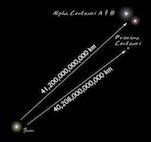
The image on the preceding page was created to demonstrate that Alpha Centauri is not a star, but really a star system. Of the three stars in the system, the dimmest - called Proxima Centauri - is actually the nearest star to the Sun. The two bright stars, called Alpha Centauri A and B form a close binary system; they are separated by only 23 times the Earth - Sun distance. This is slightly greater than the distance between Uranus and the Sun.
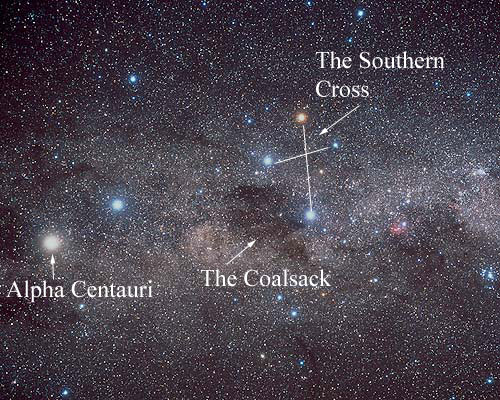
The Alpha Centauri system is not visible from much of the northern hemisphere. The below image shows this star system and other objects near it in the sky.
Distance Information
Proxima Centauri, the closest star to our own, is still 40,208,000,000,000 km away. (Or about 268,770 AU.) When we talk about the distances to the stars, we no longer use the AU, or Astronomical Unit; commonly, the light year is used. A light year is the distance light travels in one year - it is equal to 9.461 x 10¹² km. Alpha Centauri A & B are roughly 4.35 light years away from us. Proxima Centauri is slightly closer at 4.25 light years.
How Do We Calculate Distances of This Magnitude?
The methods astronomers use to measure distances to the stars are pieces of fundamental and active work in astronomy with important implications for how we understand the Universe around us.
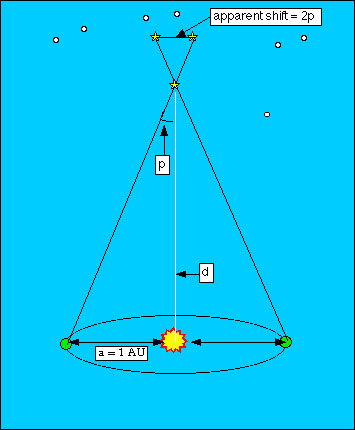
One of the most accurate methods astronomers use to measure distances to stars is called parallax. If you hold your finger in front of your face and close one eye and look with the other, then switch eyes, you'll see your finger seem to "shift " with respect to more distant objects behind it. This is because your eyes are separated from each other by a few inches - so each eye sees the finger in front of you from a slightly different angle. The amount your finger seems to shift is called its "parallax".
Astronomers can measure parallax by measuring the position of a nearby star very carefully with respect to more distant stars behind it, then measuring those positions again six months later when the Earth is on the opposite side of its orbit. If the star is close enough to us, a measurable parallax will be seen: the position of the star relative to the more distant background stars will have shifted. The shift is tiny - less than an arcsecond even for the nearest star. (An arcsecond is 1/60 of an arcminute, which is 1/60 of a degree.) (Imagine the Universe has more information on calculating parallax.)
Why Are These Distances Important To Astronomers?
Stars are not actually stationary objects! The Galaxy is rotating, and the stars are in orbit around its center. Not every star moves at the same rate - how fast they orbit can depend on where the star is located within the Galaxy. Our Sun, being fairly far from the Galactic Center, takes over 200 million years to circle the Galaxy once. Some of the stars near us are moving faster than us, and some slower. As Phil Plaitt, from Bad Astronomy says, "...like cars on a highway, stars continually pass each other as they orbit the Galaxy. They change positions, slowly, but measurably."
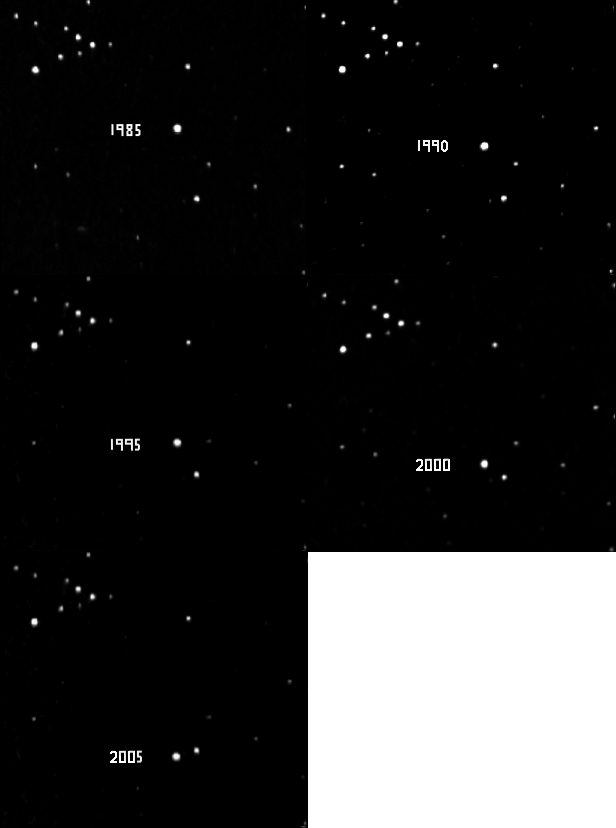
This animation by Frog Rock Observatory shows the movement of Barnard's Star across the sky from 1985 to 2005. Barnard's Star is approaching the Sun so rapidly that around 11,700 AD, it will be 3.8 light years from the Sun - and thus the closest star to our own! (Garcia-Sanchez, et al, 2001)
Travel Time
The Voyager 1 spacecraft is on an interstellar mission. It is traveling away from the Sun at a rate of 17.3 km/s. If Voyager were to travel to Proxima Centauri, at this rate, it would take over 73,000 years to arrive. If we could travel at the speed of light, an impossibility due to Special Relativity, it would still take 4.22 years to arrive!
Why Can't We Travel Faster Than the Speed Of Light?
According to Special Relativity the mass of an object increases as its speed increases, and approaches infinity as the object's speed approaches the speed of light. This means that it would take an infinite amount of energy to accelerate an object to the speed of light.
There's no fundamental reason why we can't get as close to the speed of light as we like, provided we have enough energy. But this is probably far in the future.