
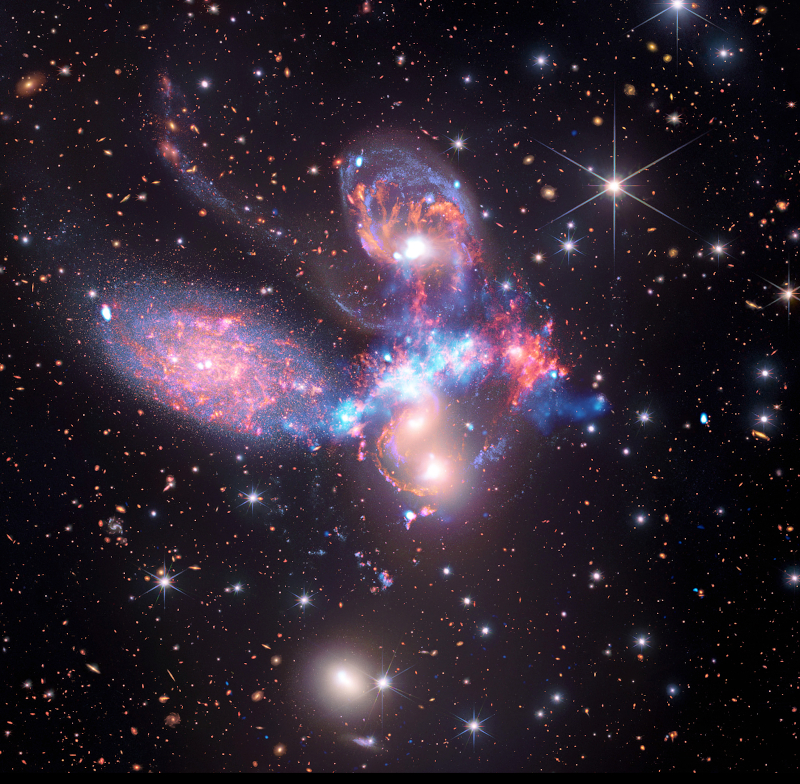
 Credit: X-ray: NASA/CXC/SAO; IR (Spitzer): NASA/JPL-Caltech; IR (Webb): NASA/ESA/CSA/STScI
The Quintet
Stephan's Quintet is a visually stunning close group of five galaxies, discovered by the French astronomer ´E;douard Jean-Marie Stephan in 1877. Four of the five galaxies which make up Stephan's Quintet are physically close, so close that they interact with each other, and perhaps one day they will merge. The fifth is an interloper, a foreground galaxy about one-seventh the distance of the other four. The four neighbors provide astronomers with an interesting view of how galaxies grow and evolve by interacting and merging. The image above shows the early-release science image of Stephan's Quintet from JWST. The JWST image (red, orange, yellow, green, blue) shows new details of the galactic interactions, like sweeping tails of gas stripped and bursts of star formation. The image above also show a high-resolution X-ray emission from the Chandra X-ray Observatory (in cyan) which highlights the high-energy shock waves as one galaxy passes through another, producing superhot, X-ray emitting gas at tens of millions of degrees.
Published: July 13, 2026
<
HEA Dictionary ● Archive
● Search HEAPOW
● Other Languages
● HEAPOW on Facebook
● Download all Images
● Education ● HEAD
>
Each week the HEASARC
brings you new, exciting and beautiful images from X-ray and Gamma ray
astronomy. Check back each week and be sure to check out the HEAPOW archive!
Page Author: Dr. Michael F. Corcoran
Last modified Monday, 13-Jul-2026 10:09:50 EDT