
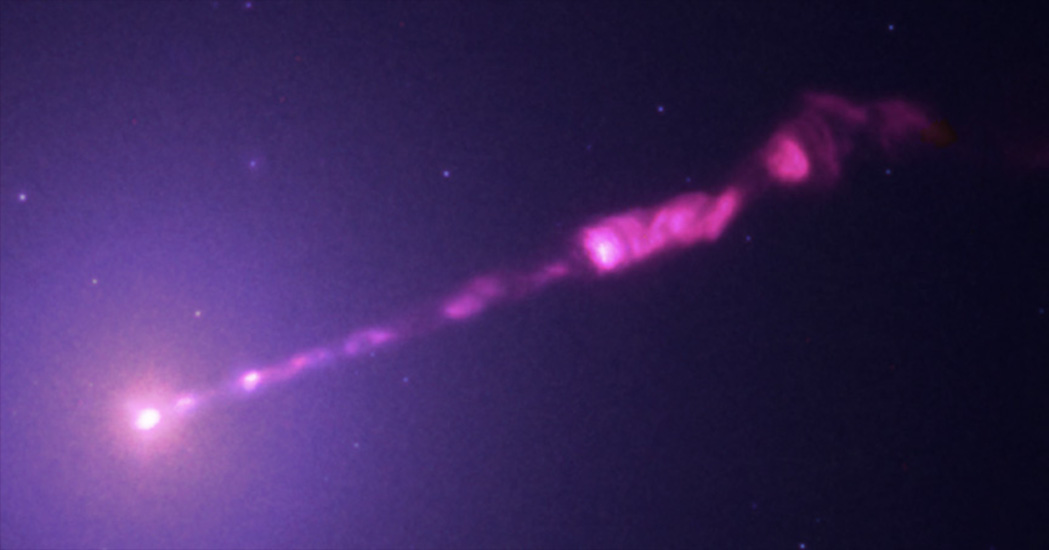
 Credit: X-ray: NASA/CXC/Univ. Laval/C. Poitras et al.; IR: NASA/CSA/STScI; Radio:NSF/NRAO/VLA; Optical: NASA/ESA/STScI; Image Processing: NASA/CXC/SAO/L. Frattare
A Jet Apparently Faster than Light
M87 is a giant elliptical galaxy which dominates the Virgo cluster of galaxies. It's famous now for its central, six billion solar mass black hole whose shadow was recently seen by the Event Horizon Telescope. As matter falls into the black hole, the release of gravitational potential energy powers strong jets of matter on either side of the black hole's accretion disk, blasting into space for millions of light years. This jet emits in radio waves, optical light and X-rays, and because of this X-ray emission it's a favorite target of the Chandra X-ray Observatory. Chandra's high definition cameras provide the best pictures we have of the structure of the X-ray emitting portion of the jet. Chandra has been studying this jet for more than twenty years, and this archive of data provides a unique resource to study how the X-ray emission from the jet evolves with time as the jet blasts its way into intergalactic space. The image above shows a new, high-resolution Chandra X-ray image of the entire length of M87's X-ray emitting jet (in purple), along with a radio from the Very Large Array (blue) and an optical image (magenta) from the Hubble Space Telescope and infrared images from JWST.
The X-ray jet
stretches for about 18,000 light years from the black hole (which is located near the bright spot at the base of the jet at the lower left). The new Chandra image shows that the jet is not smooth, but shows bright spots of X-ray emission likely produced by strong outbursts of material from the black hole due to sporadic, large increases in the amount of matter falling into the black hole. Over this timespan, Chandra has seen signifcant evolution in the jet, like the expansion of bright spots outward from the black hole, and some regions brightening in X-rays while others fade. The jet expansion seems to show surprisingly that it is moving outward at about six times the speed of light, a "superluminal" motion that apparently violates the cosmic speed limit. In reality, this is sort of an optical illusion produced by material moving at about 99% of the speed of light combined with the orientation of the jet to our line of sight.
Published: June 22, 2026
<
HEA Dictionary ● Archive
● Search HEAPOW
● Other Languages
● HEAPOW on Facebook
● Download all Images
● Education ● HEAD
>
Each week the HEASARC
brings you new, exciting and beautiful images from X-ray and Gamma ray
astronomy. Check back each week and be sure to check out the HEAPOW archive!
Page Author: Dr. Michael F. Corcoran
Last modified Monday, 29-Jun-2026 11:43:38 EDT