
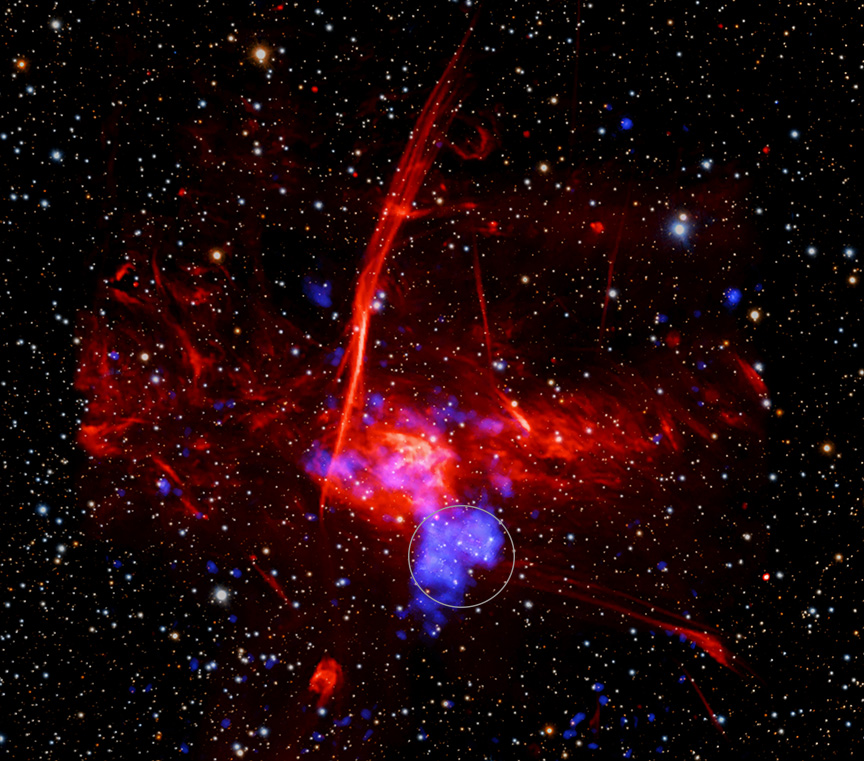
 Credit: X-ray: NASA/CXC/UCLA/Z. Zhu et al.; ESA/XMM-Newton; Optical: PanSTARRS; Radio: MeerKAT; Image Processing: NASA/CXC/SAO/L. Frattare and P. Edmonds
The Explosive Center
The center of our home galaxy, the Milky Way, is a complex region, containing large clouds of gas and dust, some of the most massive stars in our Galaxy, compact objects like pulsars, and of course our own supermassive black hole, a 4-million solar mass behemoth known as Sgr A*. And it is all immersed in clouds of diffuse, very hot gas of ill-determined origin. The history of this region is complex and violent. Now a new study of the Galactic Center, a central star-forming region called Sgr C, has perhaps uncovered an explosive piece of this violent history. Using X-ray observations from the Chandra X-ray Observatory and the XMM-Newton X-ray space telescope, researchers have identified what is perhaps evidence of the core-collapse explosion of a massive star within Sgr C, very near to Sgr A*. The false-color image above shows X-ray emission from the Sgr C region in blue, along with loops of radio emission from the region shown in red, superimposed on an optical image of the region. The circle shows a region of extended X-ray emission which scientists believe represents the hot shocked gas from a 1700 year-old supernova remnant left behind by a massive star that ran out of fuel and exploded. If confirmed, this would be the nearest supernova to Sgr A* yet identified.
Published: June 15, 2026
<
HEA Dictionary ● Archive
● Search HEAPOW
● Other Languages
● HEAPOW on Facebook
● Download all Images
● Education ● HEAD
>
Each week the HEASARC
brings you new, exciting and beautiful images from X-ray and Gamma ray
astronomy. Check back each week and be sure to check out the HEAPOW archive!
Page Author: Dr. Michael F. Corcoran
Last modified Monday, 22-Jun-2026 11:47:04 EDT