
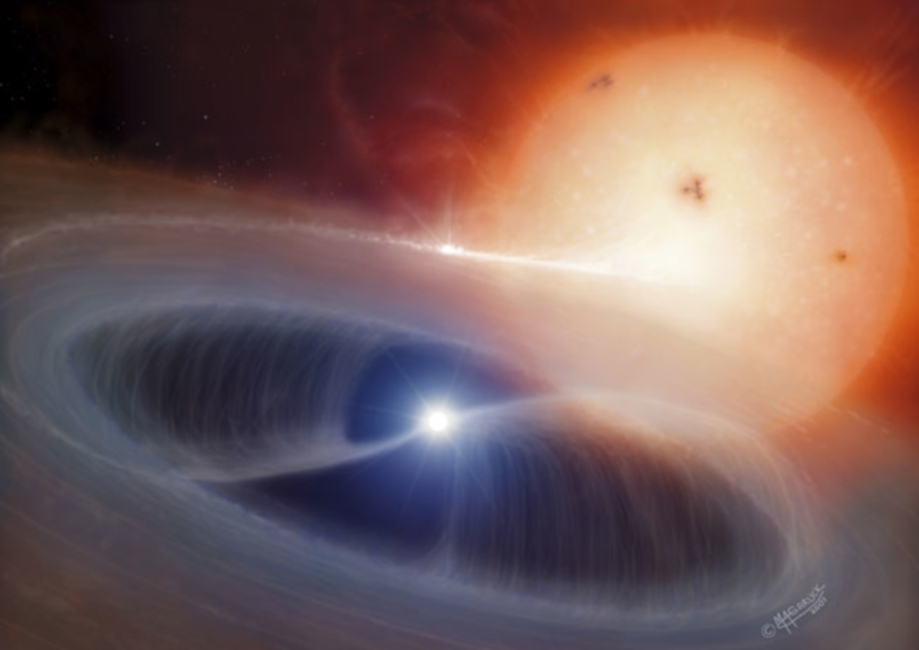
 Credit: Mark Garlick (Space-art)
End of the Line?
Starlight is produced by the conversion of mass into energy deep in a star's interior, through a process called thermonuclear fusion, where fast-moving atomic nuclei in the stellar core collide at high temperatures and transmute into nuclei of more complex elements. During this fusion process a small amount of matter is converted to energy, and this energy supports the star from collapsing in on itself due to its own gravity, and also produces the starlight we see shining from the star's surface out into space. For most of a star's life, stars fuse hydrogen nuclei together to form helium nuclei. For most (low-mass) stars, fusion ends when most of the hydrogen is used up; stars like our Sun have sufficient mass to take the next step and turn the helium nuclei previously produced into carbon. Once this fusion process stops, the star's life is over: eventually the outer part of the star detaches from the stellar core, which at this point is a cooling cinder about the size of the earth, and very dense, called a white dwarf. Sometimes these sleeping cinders spring to life by accreting matter from a companion star onto its surface; if this matter becomes hot enough and dense enough, the entire surface explodes like an H-bomb. Such systems are called "cataclysmic variables". Or, because of the weird quantum-mechanical laws that rule them, if a white dwarf becomes too massive through accretion, the entire star will explode as a supernova. This explosion is called a type Ia supernova, and is a useful standard candle to illuminate the darkest depths of the Universe. An accreting white dwarf binary system known as IGR J19713+0747 consists of a highly magnetized white dwarf being orbited by a low-mass star in a very short (13 minute) orbit. The white dwarf is accreting matter from the companion star, and the white dwarf's strong magnetic field channels the stolen streams of the companion's matter onto the north and south magnetic poles of the white dwarf. As this material rains down onto the white dwarf's poles, it also heats up to extreme temperatures, hot enough to emit X-ray radiation. A new study by NASA's Nuclear Spectroscopic Telescope Array (or NuSTAR) of the very high-energy X-rays from this system is providing important details of the accretion process, and also can help measure the mass of the white dwarf in the system to see how close the white dwarf is to exploding as a supernova.
Published: September 29, 2025
<
HEA Dictionary ● Archive
● Search HEAPOW
● Other Languages
● HEAPOW on Facebook
● Download all Images
● Education ● HEAD
>
Each week the HEASARC
brings you new, exciting and beautiful images from X-ray and Gamma ray
astronomy. Check back each week and be sure to check out the HEAPOW archive!
Page Author: Dr. Michael F. Corcoran
Last modified Monday, 17-Nov-2025 13:21:28 EST