
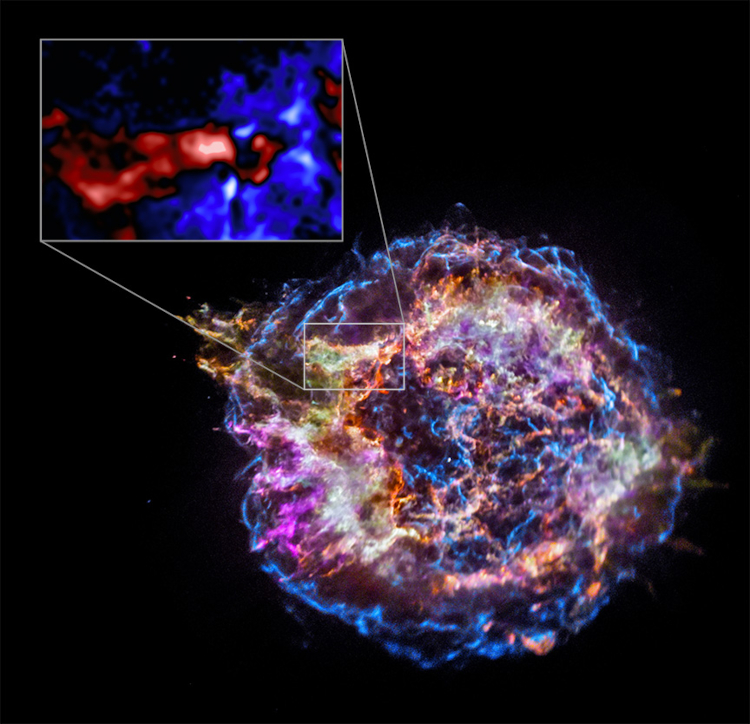
 Credit: X-ray: NASA/CXC/Meiji Univ./T. Sato et al.; Image Processing: NASA/CXC/SAO/N. Wolk
The Inside-Out Former Star
When a high-mass star explodes, it produces large cloud of expelled gas called a
supernova remnant consisting of the fast-moving material that was inside the star. So by studying supernova remnants, astronomers can in
effect study the stellar interior, exposed by the supernova. The
X-ray
image of the Cas A supernova remnant shown above, obtained by the
Chandra X-ray observatory, has given
astronomers an unbelievably detailed look at the composition of the gas in
the remnant. Through a
detailed analysis of this image astronomers have been able to determine the local composition of the gas, which gives important clues to understanding the chemical stratification of the star just before it exploded. A massive star converts simpler elements to more complex ones by nuclear fusion - first hydrogen to helium, then helium to carbon, and so on - up to iron, at which time the star collapses on itself and explodes. The fusion process means that the deeper layers of the star become enhanced with more complex elements, while the simpler elements are found in the outer region of the star. After the star explodes, the distribution of chemical elements in the ejecta provides an important test of the star's inner structure jut before the explosion. And the X-rays emitted by the hot, million-degree ejecta can be used to determine the relative abundances of the different atoms producing the specific X-ray emission.
The inset image shows a zoomed region of the nebula, where careful analysis of the emitted X-rays detected by Chandra provide measurements of the abundances of elements like oxygen, neon, silicon and iron.
Red indicates regions where the X-ray emission shows enhanced amounts of silicon, while blue indicates regions which seem enhanced in neon, a less complex element than silicon. Neon is expected to be farther out in the remnant compared to silicon, since it's expected to be in the outer layers of the star, but it's not. This seems to mean that deeper, silicon-enhanced regions inside the star traveled outwards above an outer, neon-rich layer. It's as if the star was turning itself inside out.
Published: September 22, 2025
<
HEA Dictionary ● Archive
● Search HEAPOW
● Other Languages
● HEAPOW on Facebook
● Download all Images
● Education ● HEAD
>
Each week the HEASARC
brings you new, exciting and beautiful images from X-ray and Gamma ray
astronomy. Check back each week and be sure to check out the HEAPOW archive!
Page Author: Dr. Michael F. Corcoran
Last modified Monday, 29-Sep-2025 14:49:07 EDT