
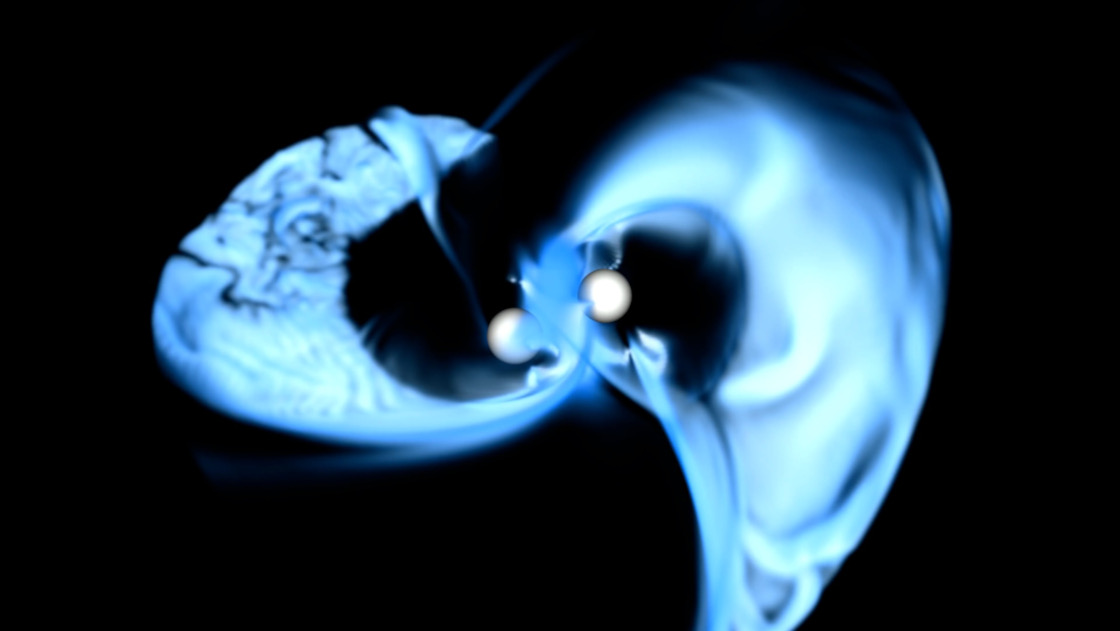
 Credit: NASA's Goddard Space Flight Center
Entanglement
Gold and other complex, neutron-rich elements are believed to be formed by the mergers of neutron stars, the ultra-dense cores of massive stars that ran out of fuel and collapsed. The only clearly identified example of such a merger is the "Golden Merger", observed in 2017 from the gravitational and electromagnetic waves it produced after the neutron stars crashed together. Scientists are greatly interested in finding merging neutron stars just before they collide, so that the entire collision, and the extreme phenomena associated with it, can be fully studied. Neutron stars usually possess strong, complicated magnetic fields powered by the dynamo of their rapid rotations, and before the neutron stars themselves collide, their strong magnetic fields become entangled, producing high-energy electromagnetic radiation as the harbinger of an impending, gold-producing neutron star collision. Now using one of the most powerful supercomputers available, the Pleiades supercomputer at the NASA/Ames Research Center in California, researchers have modeled the tell-tale high-energy emission produced by the tangled magnetic fields of merging neutron stars, and how this emission changes as the stars approach each other in the milliseconds before collision. The image above shows a simulation of two merging neutron stars (the white spheres in the center of the image), while the extended blue region shows where high energy gamma-rays are being produced by the entangled magnetic fields in the space around the two neutron stars. You can watch the simulated merger process and the interactions of each star's magnetic fields for yourself. Next-generation gamma-ray detectors may be able to use this emission as an early-warning signal of an imminent neutron star merger igniting the next cosmic gold rush.
Published: February 9, 2026
<
HEA Dictionary ● Archive
● Search HEAPOW
● Other Languages
● HEAPOW on Facebook
● Download all Images
● Education ● HEAD
>
Each week the HEASARC
brings you new, exciting and beautiful images from X-ray and Gamma ray
astronomy. Check back each week and be sure to check out the HEAPOW archive!
Page Author: Dr. Michael F. Corcoran
Last modified Monday, 16-Feb-2026 14:50:05 EST