
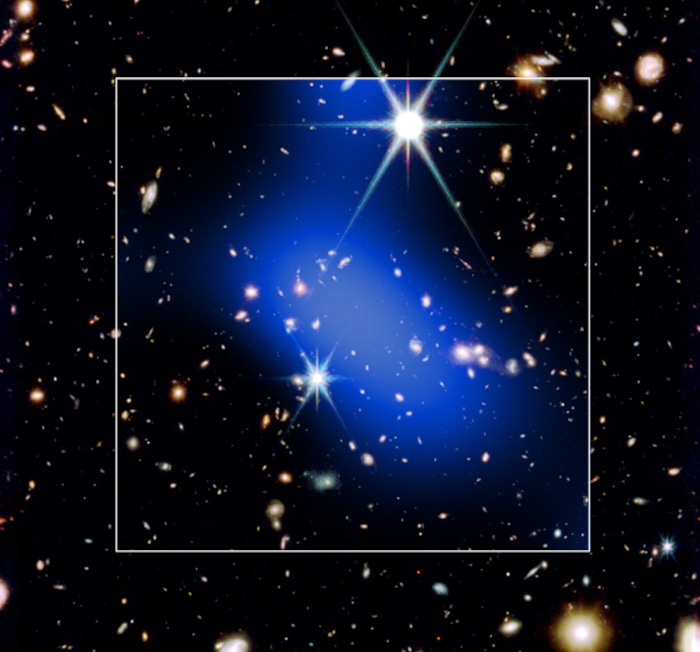
 Credit: X-ray: NASA/CXC/CfA/A. Bogdan; Infrared (JWST): NASA/ESA/CSA/STScI; Image Processing: NASA/CXC/SAO/P. Edmonds and L. Frattare
Getting an Early Start on Construction
Galaxy clusters are the largest identifiable objects in the Universe. Galaxy clusters contain dozens or hundreds of galaxies, held together by the gravitational pull of their own dark matter. They form the strands that compose the cosmic web. But where do these strands come from? Looking back in time to the distant Universe, astronomers have identified clusters that are in the process of formation. But recognizing distant protoclusters in visible-band images can be challenging, since it can be hard to clearly identify cluster member galaxies from background or foreground galaxies (or even stars). X-ray observations can help identify member galaxies by detecting X-ray emission from supermassive accreting black holes in cluster member galaxies. And combined with deep images in the infrared from NASA's large JWST telescope can help pinpoint exactly how old these clusters are, and how soon after the big bang they formed. Determining the history of cluster formation is important for our understanding of how the first stars and galaxies and supermassive black holes formed. The image above is a recent composite infrared image (from JWST) and Chandra X-ray Observatory image (in blue).
The deep JWST image shows distant, relatively large oval galaxies with discernible spiral arms, along with small unresolved points of infrared light (circled) which have been identified as individual galaxies in a distant protocluster called JADES-1. The Chandra X-ray image shows a large, glowing amorphous cloud of hot, X-ray emitting gas trapped by the combined gravitation pull of the cluster galaxies. This X-ray emitting cloud contains most of the "normal" (or "baryonic) matter - mostly protons and other atomic nuclei - in the cluster, far exceeding the amount of normal matter in the stars and gas within the cluster galaxies themselves. The JWST observations show that the cluster has a total mass of about 20 trillion times the mass of the Sun (about 20,000 times the mass of the Milky Way), and that it was formed only one billion years after the Big Bang. How such a large, massive, complex structure could have been formed so soon after the Big Bang is currently a mystery, challengine our very concepts of the early Universe.
Published: February 2, 2026
<
HEA Dictionary ● Archive
● Search HEAPOW
● Other Languages
● HEAPOW on Facebook
● Download all Images
● Education ● HEAD
>
Each week the HEASARC
brings you new, exciting and beautiful images from X-ray and Gamma ray
astronomy. Check back each week and be sure to check out the HEAPOW archive!
Page Author: Dr. Michael F. Corcoran
Last modified Monday, 09-Feb-2026 11:18:48 EST