
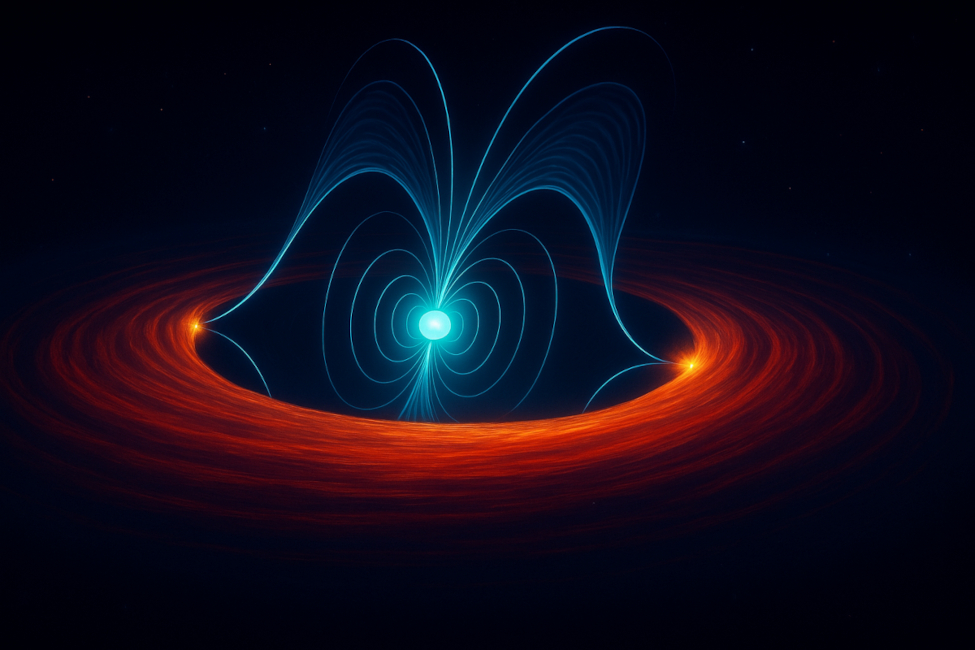
 Credit: Marco Maria Messa, University of Milan/INAF-OAB; Maria Cristina Baglio, INAF-OAB
Understanding Transitions
Neutron stars are weird, but they are also unique cosmic laboratories, allowing us to measure and test gravity and electromagnetism under conditions that are much more extreme than can ever possibly be created in a laboratory on earth. Neutron stars are the leftover compact remnants left behind after a supernova explosion, when about a Sun's worth of matter gets suddenly squeezed down to the size of a small city. This creates a fast-rotating, hot ball of neutrons and other things so dense that a tablespoon of neutron star material, if somehow brought to earth, would weigh about as much as Mount Everest. Neutron stars can spin at incredible rates, making a complete revolution in less than a second. Fast spinning neutron stars, or pulsars, can be identified by periodic flashes of radiation produced by localized bright spots as the neutron star spins. If the neutron star happens to have a companion star, interesting things can happen. The neutron star can steal material from the companion, and, as material falls onto the neutron star's surface, it adds not only mass but also angular momentum, making the neutron star spin faster. Understanding this proceess is vital for understanding how neutron stars evolve. Transitional Millisecond Pulsars are a particularly interesting class of old, spun-up neutron stars near the end of the accretion phase and left spinning at hundreds of times per second. Transitional Millisecond Pulsar change between states of high accretion when they emit lots of high-energy X-rays, and times when the accretion shuts off and the neutron star produces pulsations mostly in the radio band. A recent observation of the X-ray emission of a Transitional Millisecond Pulsar called J1023 by NASA's Imaging X-ray Polarimeter Explorer (or IXPE) has revealed for the first time important details about how this particular pulsar system transitions from one state to the other. Like other X-ray observatories in space, IXPE can measure the brightness and energy distribution of X-rays emitted by neutron stars and other sources. But, most importantly, IXPE has the unique capability to measure the polarization of the emitted X-rays as well.
Polarization is a property that describes the preferred alignment of electromagnetic radiation produced by a source. The IXPE observations of PSR J1023 showed an unexpectedly large degree of polarized flux, about 10 to 20 times larger than theoretically expected or detected from other, more "normal" neutron star systems. This surprising measurement by IXPE provides direct evidence that these polarized emissions originate from electrons accelerated by magnetic fields at the boundary where a strong wind blowing off the spinning neutron star crashes into the inner regions of the disk of accreting material around the neutron star, as illustrated in the artist's rendition above.
Published: July 21, 2025
<
HEA Dictionary ● Archive
● Search HEAPOW
● Other Languages
● HEAPOW on Facebook
● Download all Images
● Education ● HEAD
>
Each week the HEASARC
brings you new, exciting and beautiful images from X-ray and Gamma ray
astronomy. Check back each week and be sure to check out the HEAPOW archive!
Page Author: Dr. Michael F. Corcoran
Last modified Monday, 28-Jul-2025 07:48:37 EDT