
 Credit: JAXA
High Velocity Rounds
Although we commonly think of black holes as Univeral vacuum cleaners, devouring all material in their immediate area. In fact, black holes can give as good as they get, producing enormous outpourings of energy as matter spirals into the black hole. This high energy radiation can interact with matter near the black hole, powering enormous outflows. Sometimes these outflows are seen as narrow, destructive particle beams shooting from supermassive black holes at the centers of galaxies, blasting through the intergalactic space for for hundreds or thousands of light-years. The high-energy radiation a black hole produces can also drive powerful winds, blowing outwards from the black hole.
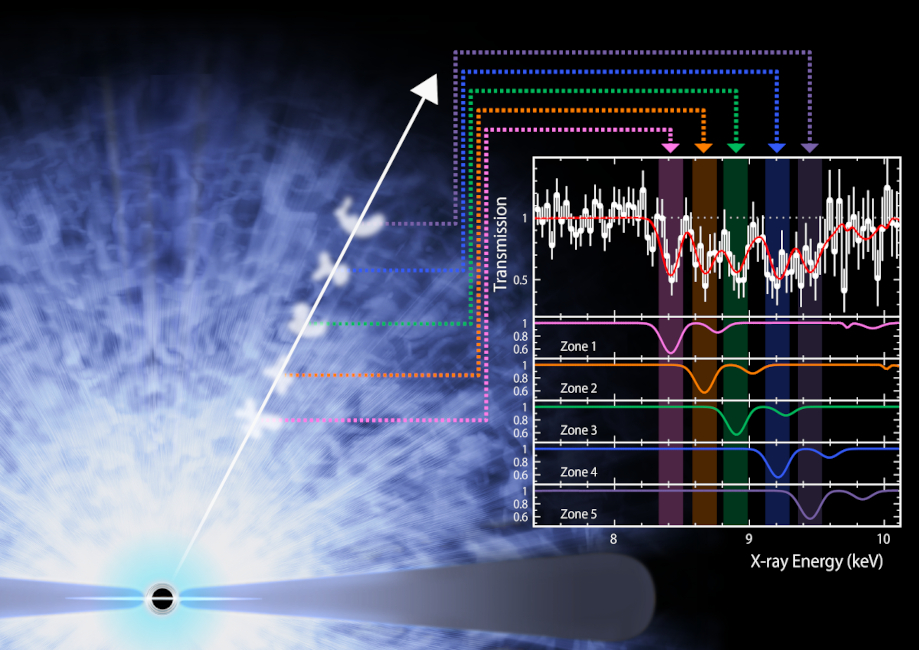
These winds, called "ultra-fast outflows" by astronomers (since they are accelerated to a good fraction of the speed of light) have a tremendous impact on the environment of the surrounding galaxy. So it's important to understand exactly how powerful these fast outflows are. New observations by the Resolve instrument on the X-ray Imaging and Spectroscopy Mission (or XRISM) of an distant galaxy called PDS 456 are helping scientists to re-define their understanding of these ultra-fast outflows. PDS 456 contains a supermassive black hole at its center, and the Resolve instrument provides unbelievably precise measures of its X-ray brightness over a wide range of X-ray energies. These observations reveal details of the atomic fingerprints produced as X-radiation is absorbed or emitted by specific atoms. The right side of the image above shows a graph of the Resolve observation of PDS 456, revealing five dips in the X-ray emission produced by the absorption of X-rays emitted near the black hole by iron atoms in five hot, distinct clouds in the wind from the supermassive black hole (as illustrated in the artist's interpretation on the left, showing a puffy white wind around the black hole, itself surrounted by a stylized accretion disk in grey). The Resolve observation shows that these wind clouds are moving outward at 20-30% of the speed of light, and that each year the wind carries a mass equivalent to a few hundred times the mass of the Sun from the black hole into the galaxy, and beyond.
Published: July 14, 2025
<
HEA Dictionary ● Archive
● Search HEAPOW
● Other Languages
● HEAPOW on Facebook
● Download all Images
● Education ● HEAD
>
Each week the HEASARC
brings you new, exciting and beautiful images from X-ray and Gamma ray
astronomy. Check back each week and be sure to check out the HEAPOW archive!
Page Author: Dr. Michael F. Corcoran
Last modified Monday, 21-Jul-2025 17:24:39 EDT