
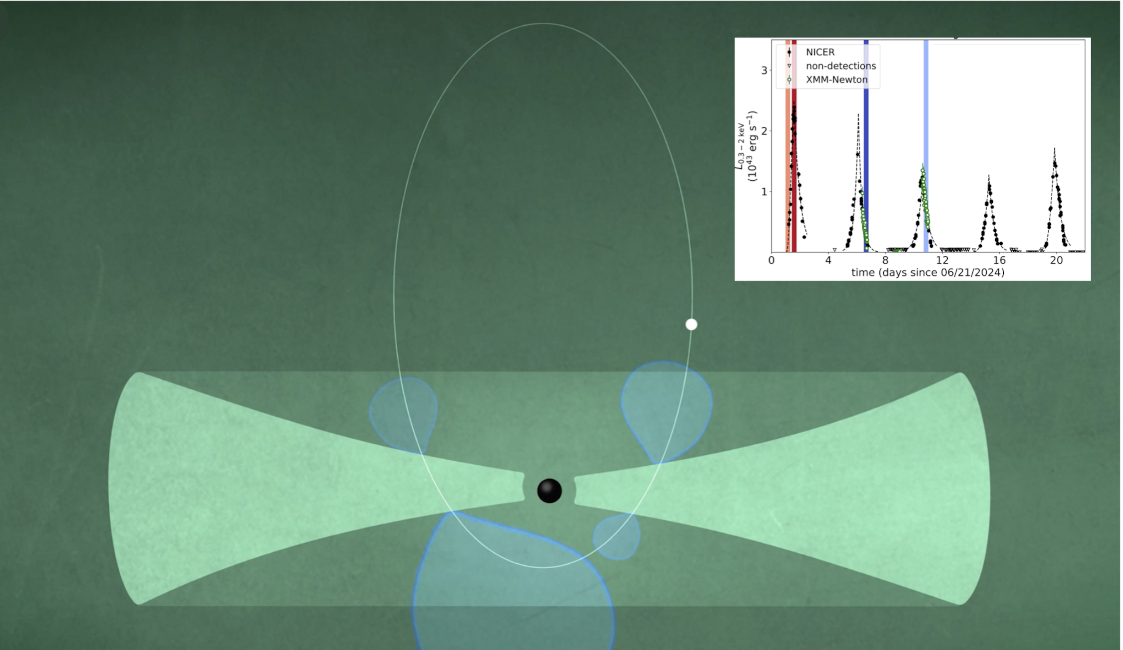
 Credit: NASA's Goddard Space Flight Center; Chakraborty, J., et al. 2025, ApJ, 984, 124.
Recurring Fireworks
Powerful, recurring X-ray outbursts have been recently identified from a small subset of galaxies. Astronomers call these outbursts "Quasi-Periodic Eruptions" (QPEs for short) since the outbursts do not occur with precisely the same period. Less than a dozen of these systems have been identified so far. The outbursts are thought to occur near a supermassive black hole (containing millions or billions of times the mass of the Sun) residing near the center of a distant galaxy. The cause of QPEs is a current matter of intense astronomical debate. In 2019, an outburst of visible light was detected by the Zwicky Transient Facility, coming from a rather innocuous galaxy about 300 million light-years from us. This unusual outburst attracted the attention of astronomers, who used NASA's exceptional current fleet of X-ray observatories (including the Chandra X-ray Observatory, the Neil Gehrels Swift observatory, the Neutron Star Interior Composition Explorer on the International Space Station, and the XMM-Newton X-ray mission) to precisely monitor the position, variability and energy of the X-rays from this galaxy. NICER and XMM-Newton observations show that the X-ray eruptions peak in brightness about every 4.5 days, and that the eruptions themselves last about 1.5 days (see inset above). These eruptions are more powerful than any seen previously. Since other known QPEs take much less than a day to repeat, the 4.5-day recurrence time and the long duration of these extremely energetic eruptions are surprising. Analysis of the combined X-ray data implies that the eruptions are caused when a small star, in an elliptical orbit around a supermassive black hole, smashes through a disk of material around the black hole every 4.5 days. The energy of the eruptions, the long recurrence time between peaks, and the long duration of the eruptions strongly suggest that this disk is unusually large and massive. The illustration above shows a small star (in white) in an elliptical orbit around the supermassive black hole (in black) which is surrounded by a disk of material (shown in cross-section in lighter green). Each time the star approaches the supermassive black hole, it crashes into the disk, and this collision ejects about a Jupiter's mass of matter (shown as the "bubbles" in light blue) at speeds approaching 15% of the speed of light, producing the energetic, nearly-periodic outburst of X-rays.
Published: July 7, 2025
<
HEA Dictionary ● Archive
● Search HEAPOW
● Other Languages
● HEAPOW on Facebook
● Download all Images
● Education ● HEAD
>
Each week the HEASARC
brings you new, exciting and beautiful images from X-ray and Gamma ray
astronomy. Check back each week and be sure to check out the HEAPOW archive!
Page Author: Dr. Michael F. Corcoran
Last modified Monday, 14-Jul-2025 17:34:15 EDT