
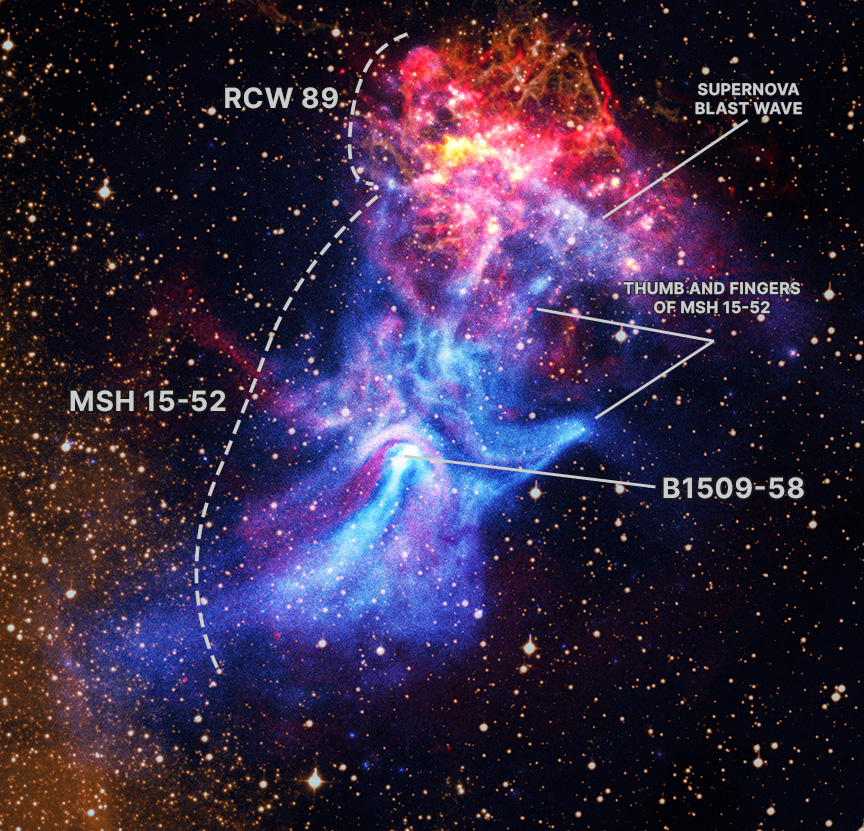
 Credit: X-ray: NASA/CXC/Univ. of Hong Kong/S. Zhang et al.; Radio: ATNF/CSIRO/ATCA; H-alpha: UK STFC/Royal Observatory Edinburgh; Image Processing: NASA/CXC/SAO/N. Wolk
A Helping Hand
What created that strange, hand-shaped object pictured above in another stunning image of the Chandra X-ray Observatory? This object is actually an extended cloud of high-energy charged particles accelerated by the intense electromagnetic field of a pulsar, a rapidly-rotating neutron star left behind by the explosion of a star which was many times the mass of the Sun. In the false-color image above,
New radio data from the Australia Telescope Compact Array (ATCA), in red, has been combined with the X-ray image in blue, orange and yellow) from Chandra to provide a fresh view of this exploded star and its environment, to help understand its peculiar properties and shape. This pulsar, a rapidly spinning neutron star, is located near the intense white dot near the center of the image, and is known as B1509-58. As B1509-58 spins, it accelerates charged particles outwards into space, forming fingers of "pulsar wind" reaching into space. Radio emission shown by the ATCA image reveals the supernova remnant called RCW
89 left behind by the stellar explosion. ATCA shows
complex filaments of radio emission aligned with the directions of the nebula's magnetic field. PSR B1509-58 and its nebulae (known as MSH 15-52) form one of the best examples of the interaction between supernovae, pulsars and the local galactic environment.
Published: August 25, 2025
<
HEA Dictionary ● Archive
● Search HEAPOW
● Other Languages
● HEAPOW on Facebook
● Download all Images
● Education ● HEAD
>
Each week the HEASARC
brings you new, exciting and beautiful images from X-ray and Gamma ray
astronomy. Check back each week and be sure to check out the HEAPOW archive!
Page Author: Dr. Michael F. Corcoran
Last modified Monday, 01-Sep-2025 12:02:31 EDT