
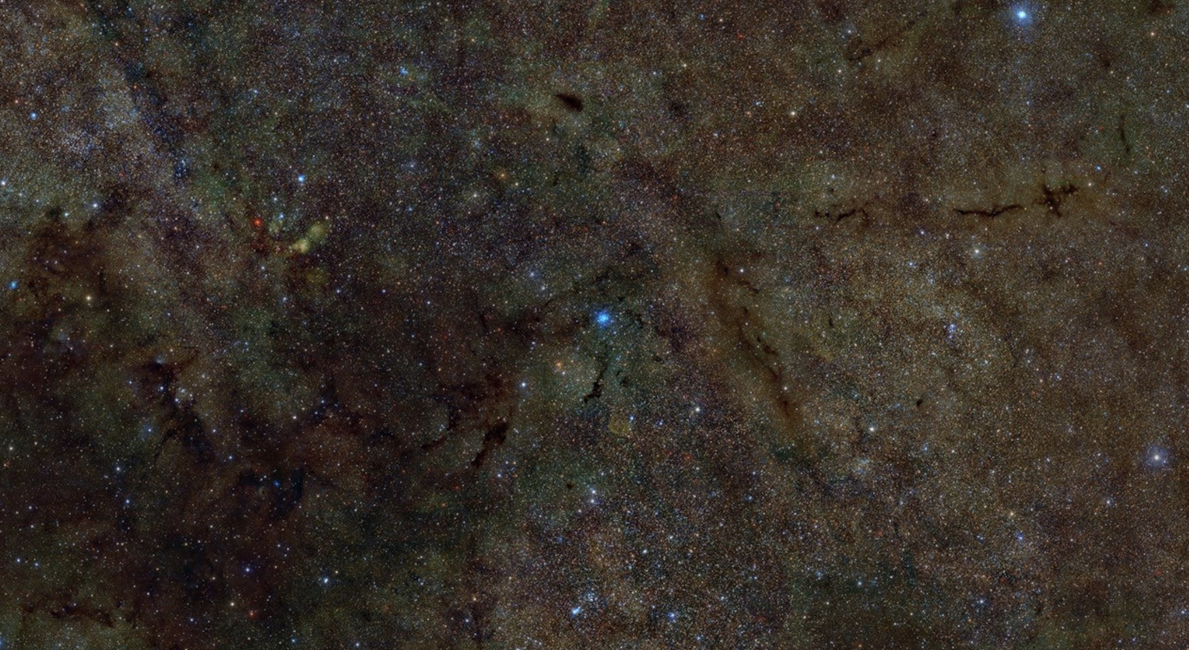
 Credit: DSS/DECaPS/eRosita/NASA-GSFC
Searching for Sulfur
Complex elements important for life, like oxygen, carbon, and sulfur (to name a few), are cooked up at the centers of stars. These elements can be distributed to the rest of the Galaxy via stellar explosions and stellar winds, where can potentially be used to build new, chemically-enriched stars, planets and people. Understanding how elements are distributed to the Galaxy, and understanding how different elements combine to form molecules and solid particles, is vital for understanding how life arose in the Milky Way (or the Universe more broadly). Studies of X-ray bright sources, like accreting neutron stars & black holes, provide an important tool for understanding the makeup of complex chemicals in the stuff between the stars (the gas and dust making up the interstellar medium, or ISM). That's because these interstellar elements imprint tiny but specific patterns in the radiated X-rays as the X-rays make their way across the Galaxy to us. A new detailed study of the X-ray emission from a neutron star in a binary system called GX 340+0 provided scientists with unprecedented details on the state of sulfur atoms along the 36,000 lightyear expanse between us and the binary. The image above shows a composite X-ray image (in blue) and optical/IR image of the Milky Way centered on GX 340+0. This study used the high-precision Resolve X-ray spectrometer on the XRISM X-ray space telescope to detect absorption patterns from galactic sulfur atoms between us and GX 340+0. Resolve's high precision not only enabled scientists to detect small absorption features produced by the combined amount of sulfur along the line-of-sight, but also showed that about half the sulfur combined with iron atoms to form tiny, solid particles of dust.
Published: August 18, 2025
<
HEA Dictionary ● Archive
● Search HEAPOW
● Other Languages
● HEAPOW on Facebook
● Download all Images
● Education ● HEAD
>
Each week the HEASARC
brings you new, exciting and beautiful images from X-ray and Gamma ray
astronomy. Check back each week and be sure to check out the HEAPOW archive!
Page Author: Dr. Michael F. Corcoran
Last modified Monday, 25-Aug-2025 16:25:03 EDT