
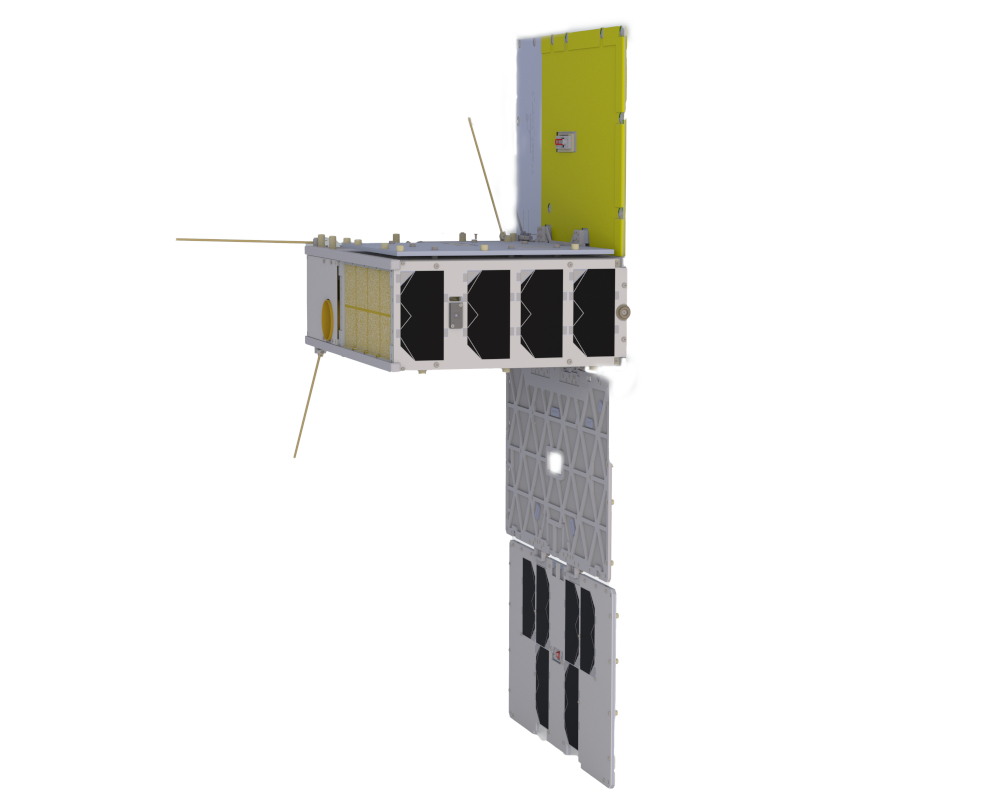
 Credit: High-Energy Astrophysical Detector & Instrumentation (HEADI) Lab at the Pennsylvania State Universit & NASA Goddard Space Flight Center, Los Alamos National Laboratory, and NanoAvionics
BlackCAT
The high-energy Universe bears watching. Stars explode, crash together, or sometimes are even torn apart and swallowed by black holes of various sizes. Ravenous black holes at the centers of galaxies spew forth powerful jets ot radiation and subatomic particles; powerful magnetic fields on fast-spinning, ultradense neutron stars can produce starquakes and enormous outpourings of energy. Watching this cosmic drama is the job of a new space observatory called the Black Hole Coded Aperture Telescope, or BlackCAT. BlackCAT is a CubeSAT, a small (11.8 by 7.8 by 3.9 inch) space satellite hosting a wide-field telescope and a novel type of X-ray detector to study powerful gamma ray bursts and other cosmic explosions. It packs a lot of scientific punch in a relatively samll package. BlackCAT studies these high-energy transients by using the shadows they cast to localize and characterize the burst. BlackCAT was designed and built by scientists at Pennsylvania State University, in collaboration with researchers at the Los Alamos National Laboratory in New Mexico, along with partners in industry. BlackCAT is pictured above, an artist illustration which shows the payload aperture and solar panels. BlackCAT was launched on a SpaceX Falcon 9 rocket from Vandenberg Space Force Base in California on January 11, 2026.
Published: January 12, 2026
<
HEA Dictionary ● Archive
● Search HEAPOW
● Other Languages
● HEAPOW on Facebook
● Download all Images
● Education ● HEAD
>
Each week the HEASARC
brings you new, exciting and beautiful images from X-ray and Gamma ray
astronomy. Check back each week and be sure to check out the HEAPOW archive!
Page Author: Dr. Michael F. Corcoran
Last modified Sunday, 25-Jan-2026 14:23:33 EST