
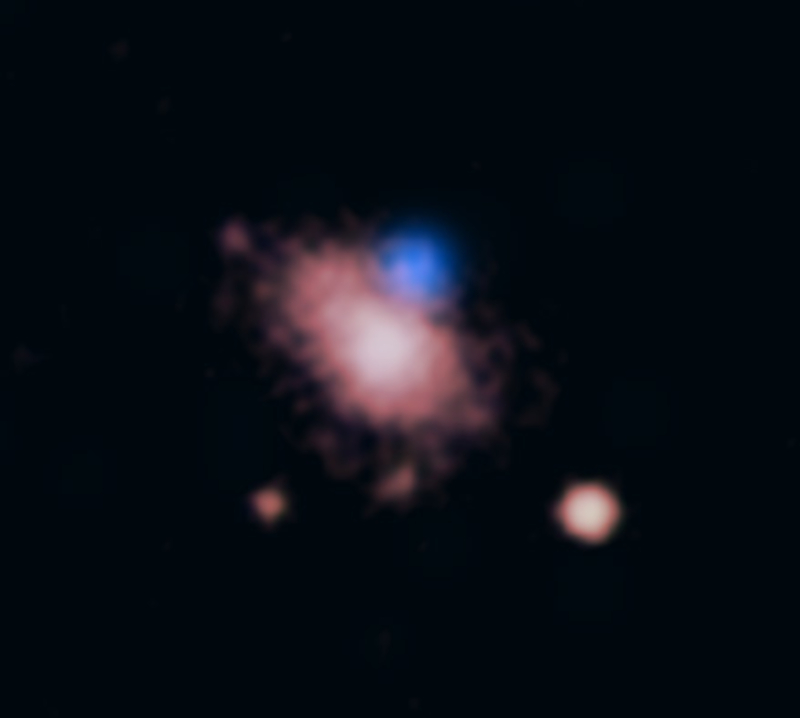
 Credit: X-ray: NASA/CXC/UC Berkeley/Nayana A. J. et al.; Optical: Legacy Surveys/DECaLS/BASS/MzLS; Image Processing: NASA/CXC/SAO/P. Edmonds and N. Wolk
Starting the New Year with a Bang
The skies are now under almost constant telescopic surveillance. Not much can happen in the heavens without someone noticing. Modern celestial surveys have discovered all manner of extremely powerful events and explosions in deep space. Some of the most mysterious events are rare, rapid, X-ray bright, blue transients whose peak luminosity rivals or exceeds that of an entire galaxy of stars, distinctive characteristics more extreme than typical supernovae. Astronomers call events like these "Luminous Fast Blue Optical Transients", or LFBOTs for short. The most recent LFBOT to be discovered is called AT2024wpp. It is more luminous than about 100 million Suns, making it the most luminous LFBOT yet discovered. Followup X-ray observations from space with the Chandra X-ray Observatory, XMM-Newton, Swift, and NuSTAR, along with ground-based radio observations, have given astronomers clues to the broad-band emission mechanism. The image above is a composite optical image (in red) and an X-ray image from the Chandra X-ray Observatory (in blue). The blue source near the galaxy at the center of the image marks the position of AT2024wpp. The combined X-ray and radio data suggest that the enormous power of AT2024wpp was probably produced when a star wandered too close to a black hole of about 100 times the mass of the Sun and was torn apart and gradually swallowed by the enormous gravity of the black hole. This stellar tidal disruption produced temporary, massive, narrow jets of matter blasting off the accretion disk around the black hole, which then slammed into thick clouds of gas and dust surrounding the black hole, producing the enormous outpouring of X-ray and radio emission seen by astronomers.
Published: January 5, 2026
<
HEA Dictionary ● Archive
● Search HEAPOW
● Other Languages
● HEAPOW on Facebook
● Download all Images
● Education ● HEAD
>
Each week the HEASARC
brings you new, exciting and beautiful images from X-ray and Gamma ray
astronomy. Check back each week and be sure to check out the HEAPOW archive!
Page Author: Dr. Michael F. Corcoran
Last modified Monday, 12-Jan-2026 11:44:37 EST