
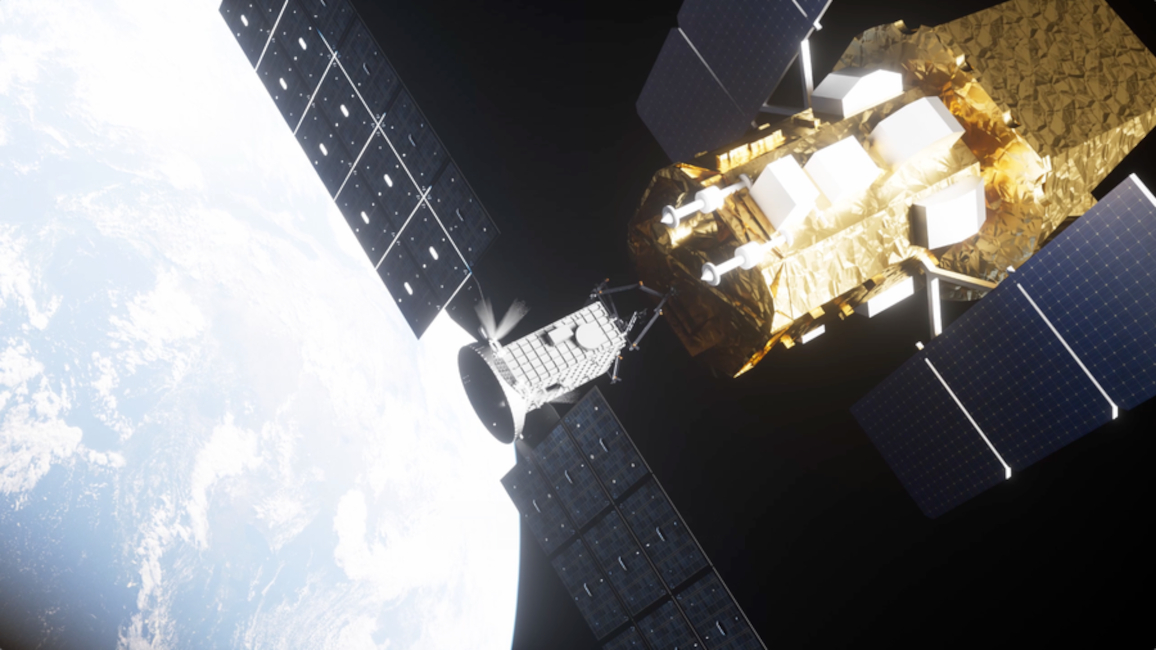
 Credit: NASA; Katalyst; Northrup Grumman
A Boost for Swift
The Swift Observatory, a NASA mission with international participation, was launched on November 20, 2004, with the goal of helping to solve the riddle of titanic cosmic eruptions called gamma-ray bursts. GRBs, as their name implies, are brief bursts of high-energy gamma radiation and were first detected in the 1970's. For decades after their discovery, why they occurred, how powerful they were, and, ultimately the cosmic source (or sources) producing these energetic eruptions were a puzzle. A breakthrough was finally achieved in February 1997, by an Italian-Dutch gamma-ray/X-ray satellite called BeppoSAX. On February 28, 1997, the Gamma Ray Burst Monitor on BepposSAX detected a gamma-ray burst, but could only provide an approximate position of the burst, not enough to uniquely identify it. But the X-ray instruments on BeppoSAX were able to pinpoint the fading X-ray afterglow of the burst, conclusively revealing that this GRB occurred in a far-away star forming galaxy, and that the power of the burst was enormous. The Swift Observatory, (renamed in 2017 as the Neil Gehrels Swift Observatory in honor of Swift's first project scientist) was designed to detect gamma-ray bursts, then almost immediately pinpoint the X-ray afterglows, and swiftly communicate the burst position to ground-based and space telescopes for followup study. Swift was designed to operate for about two years, but has been a workhorse of gamma-ray burst science for more than twenty years, detecting about 100 GRBs per year. Swift provided the first identification of a short gamma-ray burst lasting only 0.05 seconds, helping to show that such short bursts are associated with the mergers of neutron stars. Swift also detected gamma-ray outbursts produced when stars are torn apart and swallowed by black holes, so-called "tidal disruption events"; and many more ground-breaking observational results. But time has taking its toll, and Swift's orbital altitude has been declining due to friction with earth's atmosphere, swollen over the past decade by the Sun's unusually strong flaring activity associated with its 11-year sunspot cycle. NASA has put together a daring plan to rescue Swift. NASA awarded Katalyst Space Technologies a contract to build a robotic spacecraft to boost Swift to a higher orbital altitude. This spacecraft, called LINK, successfully was carried aloft from the Kwajalein Atoll on a Northrop Grumman Pegasus XL rocket launched from the company's modified L-1011 aircraft called Stargazer, at an altitude about 40,000 feet at 4:36 am EDT on Friday, July 3. The image above shows the small LINK spacecraft boosting Swift (the larger spacecraft to the right). Over the next several weeks, Katalyst will perform checkout procedures for LINK, after which LINK will approach Swift and complete a survey of the observatory, before attempting to capture it and lift it to a safe orbit.
Published: July 6, 2026
<
HEA Dictionary ● Archive
● Search HEAPOW
● Other Languages
● HEAPOW on Facebook
● Download all Images
● Education ● HEAD
>
Each week the HEASARC
brings you new, exciting and beautiful images from X-ray and Gamma ray
astronomy. Check back each week and be sure to check out the HEAPOW archive!
Page Author: Dr. Michael F. Corcoran
Last modified Monday, 06-Jul-2026 17:27:34 EDT