The Rossi X-ray Timing Explorer Mission
(1995 - 2012)
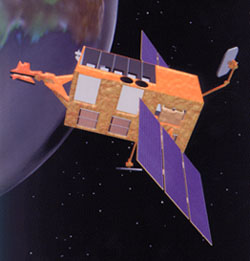 The Rossi X-ray Timing Explorer (RXTE) mission observed the
fast-moving, high-energy worlds of black holes, neutron stars, X-ray
pulsars and bursts of X-rays that light up the sky and then
disappear forever.
The Rossi X-ray Timing Explorer (RXTE) mission observed the
fast-moving, high-energy worlds of black holes, neutron stars, X-ray
pulsars and bursts of X-rays that light up the sky and then
disappear forever.
How fast and how energetic are they? Well, some pulsars spin
faster than a thousand times a second. And a neutron star produces a
gravitational pull so powerful that a marshmallow striking the star's
surface would hit with the force of an early atomic bomb.
Astronomers study changes that happen from
microseconds to months in cosmic objects to learn about how gravity works
near black holes, how pulsars in binary systems are affected by mass
transferring from one star to the other, and how the giant engines in
distant galaxies are powered.
RXTE was launched into low-Earth orbit on December 30, 1995, and after 16
years of incredible discoveries about these extreme objects, was decommissioned
on January 5, 2012. The terabytes of data in the RXTE archive will provide a wealth of information to power more discoveries for years to come.
For RXTE, the trick to observing extreme objects is all in the
timing -- an ability to observe changes in X-ray brightness that occur in
a mere thousandths of a second, or over several years.
Learn more about how
this one-of-a-kind satellite has reshaped our understanding of what goes
on in the most violent and bizarre regions of the Universe.
Enter here for images, videos and tales from the world of extremes.
|
Latest News
RXTE's 20th Birthday in Orbit (29 Dec 2015)
Happy birthday to NASA's Rossi X-ray Timing Explorer (RXTE).
RXTE was launched 20 years ago on
December 30, 1995, made thousands of observations of X-ray sources (leading to
about 2,900 refereed publications to date), and was decommissioned on January 5,
2012 (spacecraft reentry is expected in 2016). Explore the science highlights
of RXTE
here.
RXTE Reveals the Cloudy Cores of Active Galaxies (19 Feb 2014)
Using data from NASA's Rossi X-ray Timing Explorer (RXTE),
an international team
(Markowitz et al. 2014, MNRAS, in press) has uncovered a
dozen instances where X-ray signals from active galaxies dimmed as a result of
a cloud of gas moving across our line of sight.
The RXTE AGN Timing & Spectral Database (07 Nov 2013)
In this database, provided for the community by the UCSD/CASS
X-ray Group (R.E. Rothschild, A.G.
Markowitz, E.S. Rivers, and B.A. McKim), systematically-analyzed light curves
and spectra for all AGN observed by RXTE during its entire mission are now
available. The flux per observation in 4 energy bands and XSPEC-compatible
spectral data can be downloaded for any source directly from the website.
Information such as long-term average fluxes and
the typical ranges in variations of flux or photon index for a given source
should be useful in future observing programs.
 [What is this?] [What is this?]
Other News
RXTE's Major Accomplishments
|