About XL-Calibur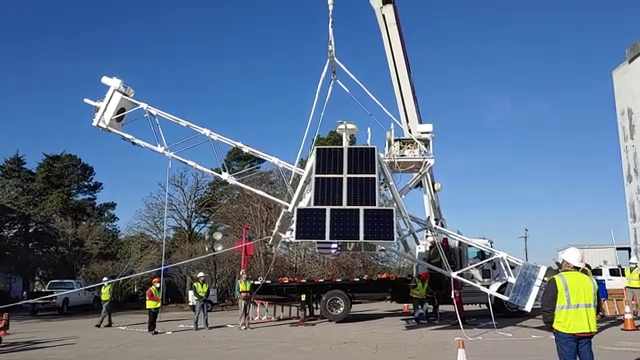
 Mission characteristics :
Mission Description:XL-Calibur is a balloon-borne X-ray telescope for studying the polarization of compact sources such as pulsars (e.g., in the Crab system) or X-ray binary systems (including Cygnus X-1). The energy range is ~15-80 keV (hard X-rays), complementary to X-ray missions such as IXPE, working in the 2-8 keV range (soft X-rays). A successful balloon flight was recently conducted, between July 9th and 14th, 2024, with a launch from the Esrange Space Center (Kiruna, Sweden) and safe parachute landing near Kugluktuk (Canada). The next flight is foreseen to take place from McMurdo (Antarctica) and can have a duration of ~8-55 days, providing access to astrophysical sources also in the southern hemisphere. A proof-of-concept mission, X-Calibur, was flown from McMurdo (Antarctica) between December 29th, 2018, and January 1st, 2019, and offered first hard X-ray polarimetric results for the X-ray binary system GX 301-2. Prior to that, X-Calibur had conducted a test flight from Fort Sumner (New Mexico, USA), in September 2016, during which the instrument could be characterized in a high-altitude background environment.
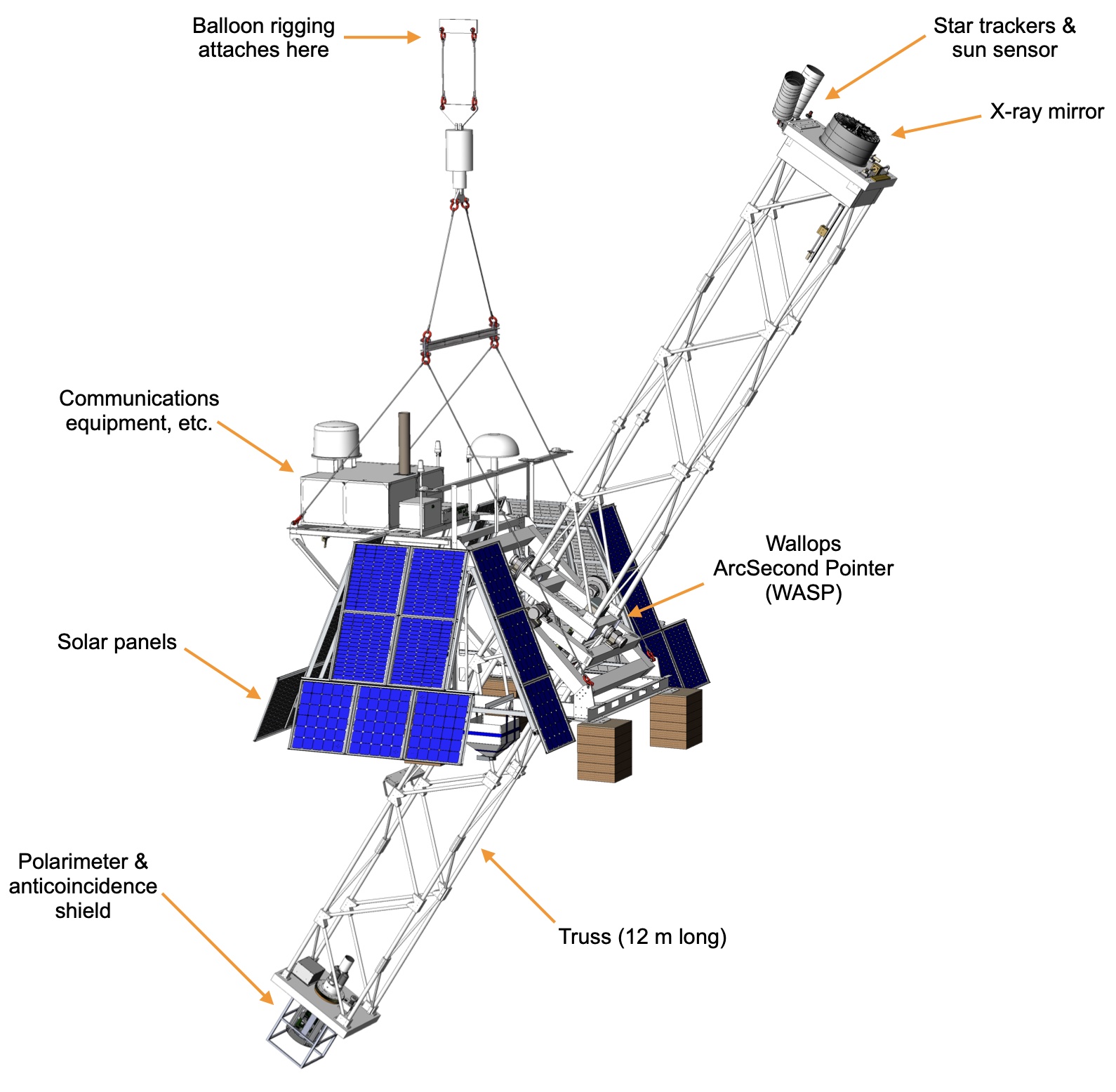
XL-Calibur uses the spare X-ray telescope from the Hitomi mission. X-rays are focused using a nested set of 213 conical shells, arranged in a Wolter type-I grazing incidence configuration with a 12 m focal length. The angular resolution is ∼2 arcmin, with an effective area of 180 cm2 at 30 keV. Platinum-carbon multi-layer coatings on the mirror extend the energy range up to ∼80 keV. The predecessor mission, X-Calibur, used the smaller InFOCμS mirror for its December 2018 flight. There, the energy range was limited to <60 keV, due to different coating materials used. At lower energies, the residual atmosphere at ∼40 km float altitude limits the energy range to >15 keV.
The XL-Calibur detector is sensitive to the linear polarization of hard X-rays through the Compton-scattering process, and it is shielded from background events (e.g., gamma-rays and cosmic rays) by an anticoincidence system. The Wallops Arc Second Pointer (WASP) provides absolute telescope pointing to 15 arcsec accuracy, with a stability of better than 1 arcsec. An azimuth rotator allows coarse orientation of the gondola assembly, with the fine tuning and precise elevation control provided by the WASP. During observations, the polarimeter assembly rotates around its optical axis at a rate of two revolutions per minute, in order to minimize systematic effects from non-uniformities in the detector. Star trackers provide pointing information. XL-Calibur includes an off-axis star tracker, offset horizontally by 25° from the pointing axis, which permits the instrument to conduct observations at high elevations, i.e., through the balloon. This secondary star tracker also provides redundancy when the on-axis camera is blocked by stratospheric clouds. A sun tracker is also available, allowing acquisition and tracking of sources in close angular proximity to the sun. 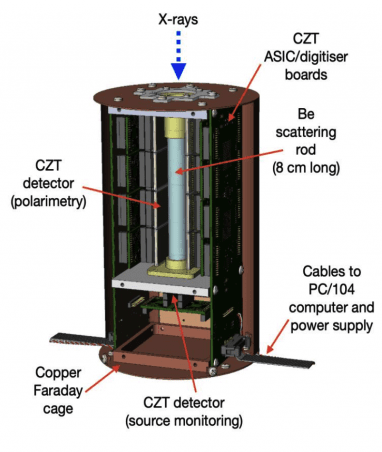
The telescope truss is made of light-weight carbon-fiber tubes, inter-connected by aluminum joints. One end of the structure has the X-ray mirror assembly, mounted on a honeycombed plate, with the detector assembly on a similar plate at the opposite end. The truss is designed to meet standard NASA flight-safety requirements, which include withstanding accelerations up to 16 g during landing, and maintaining integrity in the extreme temperature variations during launch and flight operations. The X-ray polarimeter comprises a beryllium rod, surrounded by pixelated cadmium-zinc-telluride (CZT) detectors. Their thickness has been reduced from 2 mm (X-Calibur) to 0.8 mm (XL-Calibur), providing a reduction in background rates while maintaining a high efficiency for signal detection. The energy resolution is ∼5.9 keV at 40 keV, with a ∼1 μs absolute-timing precision, enabling phase-resolved studies of millisecond pulsars such as the Crab. A CZT detector at the rear of the scattering rod is used to monitor the position of the source focal point within the field of view. The anticoincidence shield is made of bismuth germanium oxide (BGO), and it reduces the background by four orders of magnitude during flight, from the several-kHz-level rate impinging upon the shield to a ∼0.3 Hz residual background in the detector. XL-Calibur publicationsLatest News08 Aug 2025The XL-Calibur archive opens at the HEASARC for the initial data release. The HEASARC currently holds event and spectra data, with calibration data slated to be released in a future update.
19 Mar 2025Publication of the first results from the 2024 XL-Calibur observations of the Crab Nebula and Pulsar.
14 Jul 2024The XL-Calibur mission concluded a 6-day long flight, terminating close to Kugluktuk, Nunavut, Canada. During the flight, XL-Calibur successfully gathered 4 days of observational data.
09 Jul 2024The XL-Calibur balloon from NASA was successfully launched at 05:04 local time on the 9th of July from Esrange Space Center (Sweden). The flight is expected to last 4-5 days and it is possible to follow its journey across the Atlantic before landing in northern Canada.
|




- HEASARC Director: Vacant
- NASA Official: Ryan Smallcomb
- Web Curator: J.D. Myers
- Last Modified: 11-Aug-2025