About CALET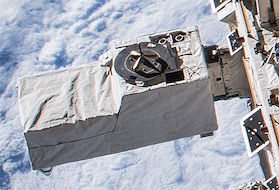
 Publications:
Mission Description:
Publications:
Mission Description:The CALorimetric Electron Telescope (CALET) is a Japan-led international mission funded by the Japanese Space Agency (JAXA) in collaboration with the Italian Space Agency (ASI), NASA and several universities in Japan, Italy, and the United States. The instrument was launched on August 19, 2015 by a Japanese carrier H2 Transfer Vehicle (HTV), and robotically installed on the Japanese Experiment Module-Exposed Facility (JEM-EF) on the International Space Station (ISS). First events were recorded in October 2015. It was initially intended for five years of operations, but has been kept operating since and will continue to do so for as long as the instruments remain functional. CALET consists of three instruments, with supporting electronics and mission support features. These are the Calorimeter (CCAL), the Gamma Ray Burst Burst Monitor (CGBM), and the Advanced Stellar Compass (ASC). 
The CCAL instrument has three sections: the Charge Detector (CHD), the Imaging Calorimeter (IMC), and the Total Absorption Calorimeter (TASC). Collectively, they measure the cosmic-ray total electron spectrum from ∼1 Gev to ∼10 TeV. The CHD is a hodoscope (a device for detecting and tracking particle showers and determining trajectories) which makes absolute charge measurement. It contains two orthogonal layers. Each layer contains of 14 plastic scintillator paddles measuring 45 × 3.2 × 1 cm. This material absorbs the incident ionizing radiation and re-emits the absorbed energy as light, which is detected and measured by photomultiplier tubes. It can detect charge for particles with atomic numbers between 1 and ∼40 Z. The IMC consists of 16 layers of scintillating fibers with 1 mm2 cross section, with alternating layers arranged orthogonally. Each alternating layer has a thin tungsten absorber, and the instrument is topped with a silicon detector array which has two layers, each 500 μm thick. The detector array provides charge resolution and the scintilling fiber layers detects the starting point of the particle shower and incident particle trajectory while distinguishing incident from backscattered particles. The entire thickness of the IMC is ∼3 radiation lengths (X0). The TASC contains a set of “logs” made of lead-tungsten that function as absorbers. Each log is 32.6 × 1.9 × 2.0 cm and the detector contains 12 layers of these logs, arranged orthogonally in alternating layers, with 16 logs in each layer. An incident event triggers a photomultiplier at the top level, and avalanche photodiodes measure the depth of penetration in order to assess the energy. The instrument can seperate electrons and gamma rays from incident hadrons. The total depth of the TASC is 27 X0. The depth of the complete calorimeter allows for nearly total containment of all the electromagnetic showers from primary electrons and photons up to tens of TeV. However, the instrument is only about 1.3 proton interaction depths, effectively filtering out much of the proton signal. One of the unique capabilities of CALET is the ability to measure electron energies above 1 TeV where the proton cosmic ray flux is typically vastly higher than the photon and electron flux. 
The CGBM consists of three detectors: two identical Hard X-Ray Monitors (HXM) sensitive from ∼7 keV – 1 MeV, and a single Soft Gamma-ray Monitor (SGM) sensitive to 100 keV – 20 MeV. These instruments can detect gamma-ray burst sources over a wide energy range, as well as monitoring soft gamma repeaters, terrestrial X-ray flashes, solar flares, and X-ray binary star activity. The instrument is also used on concert with the ASC to spot coincident optical flash sources for gamma-ray burst events. The HXM instruments uses a LaBr3(Ce) scintillator, with two cylindrical disks stacked on each other, each 6.35 mm thick, with the front disc being 66.0 mm in diameter and the second being 78.7 mm in diameter. The entrance window is covered in beryllium for detecting X-rays below 10 keV. 
The SGM instrument uses a Bi4Ge In addition to its functionality for detecting optical counterparts for gamma ray transient events, the ASC also functions as a star tracker, providing high accuracy pointing information for the entire CALET system.
CALET Mission and Instrument References:
CALET Science References:
Latest News17 November 2025CALET CGBM Data at HEASARC UpdatedThe HEASARC has added the CALET Gamma Ray Burst Monitory (CGBM) version 3.2a data to the archive, which contains data from the two Hard X-ray Monitor and Soft Gamma Ray Monitor instruments. The data is now complete up to the end of June 2025.
1 Aug 2025CALET Calorimeter Spectra at HEASARC UpdatedNew CALET Calorimeter spectra data are available at the HEASARC for new elements, including proton/electron rates.
|



- HEASARC Director: Vacant
- NASA Official: Ryan Smallcomb
- Web Curator: J.D. Myers
- Last Modified: 28-May-2025