
Come analyze HEASARC, IRSA, and MAST data in the cloud! The Fornax Initiative is now welcoming all interested beta users.
Dr. Tahir Yaqoob
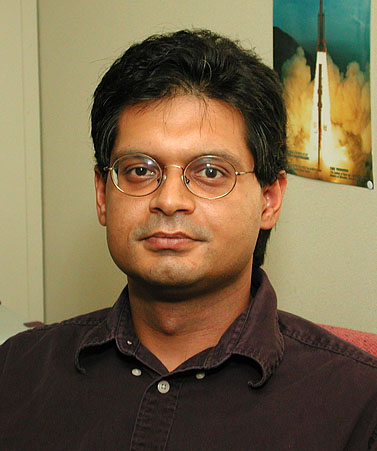
- Employer: University of Maryland Baltimore County
- Job Description: Astrophysicist
- Phone: 301-286-5015
- Fax: 301-286-1684
- e-mail: yaqoob@milkyway.gsfc.nasa.gov
- Home Page
- Curriculum Vitae
A Brief History
Tahir Yaqoob obtained a B.A. (Hons) in Physics at the University of Oxford, UK, in 1986 and a PhD in X-ray Astronomy at the University of Leicester, UK, in 1990. He subsequently continued his research in X-ray astronomy, at the Institute of Space and Astronautical Science (ISAS), Japan on a Royal Society/ JSPS Fellowship and then at the Institute of Astronomy, Cambridge, UK on a Royal Society Fellowship. From October 1992, Dr. Yaqoob worked in the Exploration of the Universe Division (formerly LHEA) at NASA/ Goddard Space Flight Center on data from the ASCA satellite, as a member of the ASCA mirror (XRT) team and Science Working Group (SWG). He was also a member of the ASCA Guest Observer Facility (GOF) and of the SWG of the X-ray astronomy missions Astro-E and Astro-E2 (Suzaku) From 2000 to 2013, Dr. Yaqoob was at Johns Hopkins University, working on a number of NASA-funded projects as PI, attaining the rank of Principal Research Scientist. Since 2013, he has been a senior research scientist with the University of Maryland Baltimore County (UMBC), at GSFC in the Astrophysics Science Division (ASD), as a member of the Hitomi Software and Calibration Team (SCT) and Hitomi SWG.Research Interests
Dr. Yaqoob's research interests focus on high-energy observational and theoretical probing of the physical properties of astrophysical sources using observations. He has published papers on various topics that include: physical processes in black-hole accretion disk systems and their environment (mostly active galactic nuclei, or AGN, and quasars but including X-ray binary systems); blazars (including TeV observations); X-ray and UV absorption and photoionized outflows and inflows in AGN and quasars; high spectral-resolution X-ray spectroscopy; X-ray signatures of strong gravity effects and black-hole spin; X-ray reflection spectra from accreting sources; power spectra, spectral and temporal variability; normal and starburst galaxies; AGN unification; low-luminosity AGN; Cosmic X-ray background; coordinated multi-wavelength and multi-mission monitoring campaigns of AGN; a high~$z$ cluster of galaxies; absorption in the warm/hot intergalactic medium (WHIGM); statistics; analysis methods; numerical and Monte Carlo modeling. One of the models developed, mytorus, can be used for direct spectral-fitting analyses of X-ray data, and was made publicly available, and widely used in the literature.