X-ray Fluorescence and X-ray Diffraction: Lunar and Planetary Surface Science
The NICER-derived Modulated X-ray Source (MXS) can support fast, in situ elemental and
mineralogical measurements for exploration via a combination of X-ray Fluorescence (XRF) and X-ray Diffraction (XRD) methods.
The QuERI handheld instrument provides in-situ XRF-based geochemical analysis for science,
rapid sample triage, and resource identification and utilization. Modulated X-ray application stimulates
fluorescence in rocks, boulders, and regolith, while silicon detectors capture characteristic spectral lines in
the returning X-rays. On-board analysis quickly uses this information to identify component
elements of the selected sample. Analysis reference information can be tailored to the specific target
landing or exploration area to improve accuracy.
The QuERI instrument will provide:
Portable real-time geochemical analysis for rocks, regolith, and boulders.
Quantification of abundances of major lunar rock-forming elements from Sodium through Zinc.
Sample prioritization information for efficient crew decision-making.
Functionality fit for human explorers in a small, lightweight, low power, and rechargeable EVA-informed design.
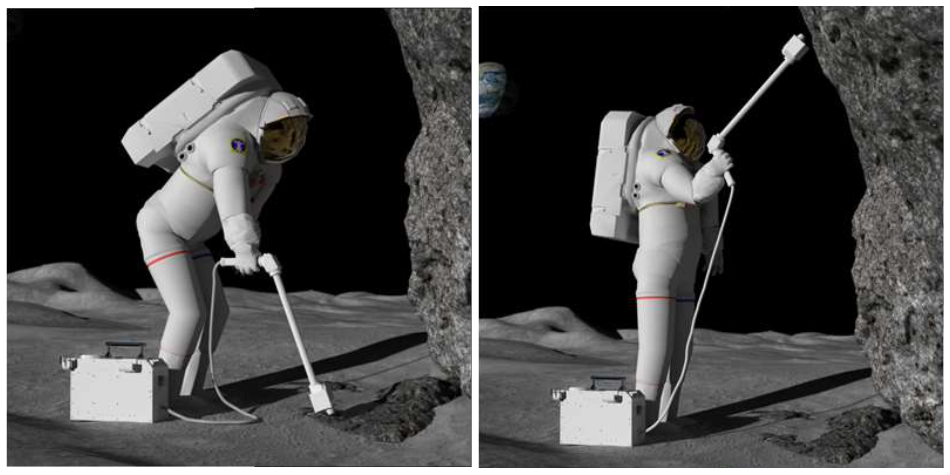
Visualization of NASA explorer using the QuERI handheld
intrument to analyze in-situ samples.
Value for Artemis-class missions
In-situ geochemical sample identification would be a new capability for human Moon-Mars exploration and
science. An initial composition analysis allows explorers to optimize their sample collection and
improve efficiency of up-mass and crew time on the surface. In addition, recording of
in-situ measurements offers the only opportunity to analyze samples that are not collected and returned
to Earth. Scientifically, this advances our understanding of formation,
evolution, and differentiation of the Moon.
Resource location and identification allows NASA to target resource-rich regions,
enabling future long-duration stays.