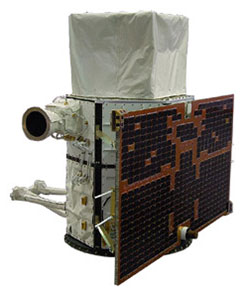
The Astro-rivelatore Gamma a Immagini Leggero (AGILE) is a gamma-ray astronomy mission operated by ASI (Italian Space Agency). It was launched on April 23, 2007 from Satish Dhawan Space Centre in India. The original plan called for a three year mission, but the satellite operated for 17 years and ceased the scientific observations on Jan 18, 2024. The satellite re-entered the Earth’s atmosphere on Feb 14, 2025. It was launched into a near-equatorial orbit, giving it a good observational vantage on terrestrial gamma-ray flashes from thunderstorms and intense atmospheric electrical activity, in addition to its astrophysics observations.
Mission Characteristics
Lifetime
23 Apr 2007–18 Jan 2024
Special Features
Extremely rapid gamma-ray burst alerts, with initial estimated events announced within an hour of observation, and a refined alert within 3 to 3.5 hours. The rapid trigger systems have detected terrestrial gamma-ray sources from equatorial thunderstorms.
Lifetime
23 Apr 2007–18 Jan 2024
Special Features
Extremely rapid gamma-ray burst alerts, with initial estimated events announced within an hour of observation, and a refined alert within 3 to 3.5 hours. The rapid trigger systems have detected terrestrial gamma-ray sources from equatorial thunderstorms.
Payload
Instrument
Characteristic
Details
SuperAGILE
Energy Range
15–45 keV
Angular Resolution
6′
Coded mask image hard X-ray detector with silicon microstrip detectors with one-dimensional angular resolution over a wide field of view. These were arranged perpendicularly to determine two-dimensional source placement. Because celestial gamma-ray sources frequently have small photon counts and considerable angular confusion, SuperAGILE was often vital to source identification.
Gamma Ray Imaging Detector (GRID)
Energy Range
30 MeV – 50 GeV
GRID contained a silicon-tungsten tracker, anti-coincidence system, and a cesium iodide calorimeter (see MiniCalorimeter; below). The tracker consisted of a set of two-layer silicon microstrip detectors, interleaved with tungsten foil: gamma rays struck the tungsten, converting into electron/positron pairs which were tracked by the microstrips to reconstruct the incident gamma ray’s direction.
MiniCalorimeter
Energy Range
350 keV – 100 MeV
Part of the GRID instrument, but operated independently as needed. Used perpendicular pairs of CsI scintillating bars.
SuperAGILE
Energy Range
15–45 keV
Angular Resolution
6′
Coded mask image hard X-ray detector with silicon microstrip detectors with one-dimensional angular resolution over a wide field of view. These were arranged perpendicularly to determine two-dimensional source placement. Because celestial gamma-ray sources frequently have small photon counts and considerable angular confusion, SuperAGILE was often vital to source identification.
Gamma Ray Imaging Detector (GRID)
Energy Range
30 MeV – 50 GeV
GRID contained a silicon-tungsten tracker, anti-coincidence system, and a cesium iodide calorimeter (see MiniCalorimeter; below). The tracker consisted of a set of two-layer silicon microstrip detectors, interleaved with tungsten foil: gamma rays struck the tungsten, converting into electron/positron pairs which were tracked by the microstrips to reconstruct the incident gamma ray’s direction.
MiniCalorimeter
Energy Range
350 keV – 100 MeV
Part of the GRID instrument, but operated independently as needed. Used perpendicular pairs of CsI scintillating bars.