
Come analyze HEASARC, IRSA, and MAST data in the cloud! The Fornax Initiative is now welcoming all interested beta users.


HXMT - Insight


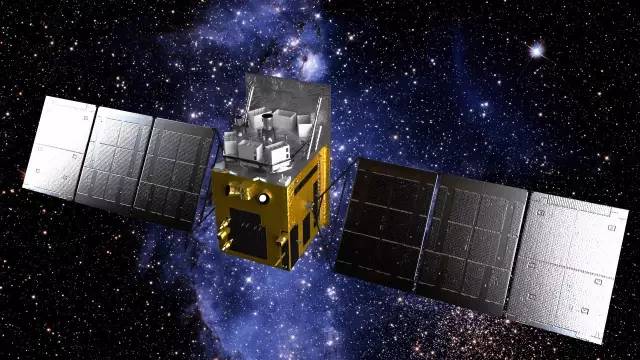
Artistic impression of HXMT The Hard X-ray Modulation Telescope (HXMT), also known as Insight, is a Chinese X-ray observatory launched on 15 June, 2017 aboard a Long March 4B rocket from the Jiuquan Satellite Launch Center. The mission provides high resolution imagery across a wide spectrum of X-ray energies.

Mission Characteristics

Lifetime
2017–
Special Features
  • China’s first dedicated X-ray astronomy mission
  • Combination of large field of view with wide-area coverage and good sensitivy by using modulation collimation

Payload

Low Energy (LE) instrument

Energy Range
1–12 keV
Effective Area
384 cm2
Field of View
1.6° × 6°
4° × 6°
60° × 6°
Angular Resolution
1′
Energy Resolution
140 eV at 5.9 keV (FWHM)
Time Resolution
0.98 ms
The LE contains three detector boxes with Swept Charge Devices (SCD) which work in a continuous read-out mode, in contrast to more traditional CCD detectors with fixed exposures times, giving it greater time resolution. Each box contains 30 fields-of-view: 21 with 1.6° × 6° (with one blocked for background measurements), 7 with 4° × 6° (with one block) and two with 50–60° × 2–6°. The three boxes are set 120 degrees apart from each other, so signals from each can reconstruct image information through demodulation.

Medium Energy (ME) instrument

Energy Range
5–30 keV
Effective Area
952 cm2
Field of View
1° × 4°
4° × 4°
Angular Resolution
1′
Energy Resolution
15% at 20 keV (FWHM)
Time Resolution
240 µs
The ME uses 1728 Silicon-PIN diodes for detecting X-rays. The instrument is divided into three detector groups: the first has a 1° × 4° FOV, a second with 4° × 4° FOV for background measurement, and a third fully blocked module for assessing dark current noise contributions to any detected signal.

High Energy (HE) instrument

Energy Range
20–350 keV
Effective Area
5100 cm2 (combined)
Field of View
1.1° × 5.7°
5.7° × 5.7°
Angular Resolution
1′
Energy Resolution
≤17% at 60 keV
Time Resolution
4 µs
The HE consists of two concentric rings of 18 total NaI/CsI phosphor sandwich (phoswich) scintillation detectors with collimators for 1.1° × 5.7° FOV in different orientations (save for two detectors, with wider fields for background monitoring, and one with a tantalum shield for monitoring dark current background). The HE instruments can perform simultaneous spectral, timing, and imaging operations .

Science Goals

  • Scan the Galactic Plane to find new transient sources and to monitor the known variable sources
  • Observe X-ray binaries to study the dynamics and emission mechanism in strong gravitational or magnetic fields
  • Find and study Gamma Ray Burst sources with its anti-coincidence detectors
  • Observe outburst events from black hole binaries