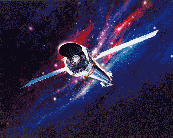
The Chandra X-ray Observatory (formerly the Advanced X-ray Astronomy Facility (AXAF)), named in honor of Subrahmanyan Chandrasekhar, was launched and deployed by the Space Shuttle Columbia on July 23, 1999. The combination of high resolution, large collecting area, and sensitivity to higher energy X-rays allows Chandra to study extremely faint sources, sometimes strongly absorbed, in crowded fields. Chandra was boosted into an elliptical high-earth orbit that allows long-duration uninterrupted exposures of celestial objects.
Mission Characteristics
| Lifetime |
23 Jul 1999 — present (nominal 5 year mission) |
| Special Features |
- 64 hour highly eccentric Earth orbit, allowing up to 56 hour long continuous observation cycles
- Very high (<1′) spatial resolution
|
Payload
Single Wolter Type 1 grazing incidence iridium-coated imaging telescope with 10 m focal length. A set of four detectors can be inserted, one at a time, into the focal plane. Two of these were designed to be used primarily with the gratings.
| Instrument |
Characteristic |
Details |
| Telescope |
Effective Area |
800 cm2 at 0.25 keV 400 cm2 at 5 keV |
| Focal Length |
10.0 m |
| Field of View |
∼30′ (ghost free) |
| A single Wolter Type 1 grazing incidence iridium-coated imaging telescope with four detectors than can be inserted, one at a time, into the focal plane. Two of these were designed to be used primarily with the gratings. |
| AXAF CCD Imaging Spectrometer (ACIS) |
Energy Range |
0.2–10 keV |
| Effective Area |
340 cm2 at 1–6 keV |
| Field of View |
16′ × 16′ (ACIS-I) 8′ × 48′ (ACIS-S) |
| Energy Resolution |
E/ΔE = 20–50 (FI) 9–35 (BI) at 1 and 6 keV |
| Two CCD arrays with a total of 10 chips. 8 chips are Front Illuminated (FI) and 2 are Back Illuminated (BI). The ACIS-I (imaging) consists of four chips, all FI. The ACIS-S (spectroscopic array) contained 4 FI and 2 BI chips. |
| High Resolution Camera (HRC) |
Energy Range |
0.1–10 keV |
| Effective Area |
225 cm2 at 1 keV |
| Field of View |
∼30′ × 30′ (HRC-I) 7′ × 97′ (HRC-S) |
| Angular Resolution |
0.5″ |
| Time Resolution |
16 µs |
| Two micro-channel plate detectors, HRC-I (optimized for imaging) and HRS-S (optimized for use with LETGS). HRC-I is a single 90 mm square detector; HRC-S is 20 × 300 mm rectangular detector |
| High Energy Transmission Grating Spectrometer (HETGS) |
Energy Range |
0.5–10 keV |
| Energy Resolution |
60–1000 E/ΔE; |
| The transmission grating could be inserted to be used in combination with one or the other of the spectroscopic detectors |
| Low Energy Transmission Grating Spectrometer (LETGS) |
Energy Range |
0.08–6 keV |
| Energy Resolution |
30–2000 E/ΔE; |
| The transmission grating could be inserted to be used in combination with one or the other of the spectroscopic detectors |
Science Highlights
- First every look at X-ray wavelengths of the compact object at the core of Cas A
- Resolved ring around central pulsar and jet structure
- X-ray images of shock waves from SN 1987a
- First X-ray emission lines from a Gamma Ray Burst (GRB 991216; “Beethoven Burst”)
- Found nearly all main sequence starts are X-ray emitters
Archive
The HEASARC hosts a copy of the Chandra archive and some catalogs