Energy Range
7 keV – 1 Tev
CCAL measures the cosmic ray particle spectrum. It consists of three subunits: The Charge Detector (CHD), IMaging Calorimeter (IMC), and Total AbSorption Calorimeter (TASC).
CHD is a plastic scintillator hodoscope for absolute charge measurement. It contains two orthogonal layers. Each layer contains of 14 plastic scintillator paddles measuring 45 × 3.2 × 1 cm. It can detect charge between 1 and ∼40 Z . IMC is a sampling calorimeter located beneath CHD. It consists of 16 layers of scintillating fibers (SciFi) with 1 mm2 cross section, with alternating layers arranged orthogonally. It also includes interspacing thin tungsten absorbers, and tracks early show profile through the first 3 X0. TASC sits beneath IMC and consists of a thick lead tungstate (PWO) hodoscope with 12 alternating layers of X-Y arranged logs, with a total shower depth of 27 X0.

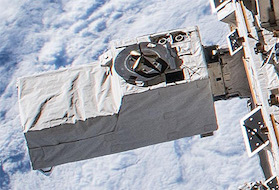 The CALorimetric Electron Telescope (CALET) is a Japan-led international mission funded by the Japanese Space Agency (JAXA) in collaboration with the Italian Space Agency (ASI), NASA and several universities in Japan, Italy, and the United States. The instrument was launched on August 19, 2015 by a Japanese carrier, H2 Transfer Vehicle (HTV), and robotically installed on the Japanese Experiment Module-Exposed Facility (JEM-EF) on the International Space Station (ISS). First events were recorded in October 2015.