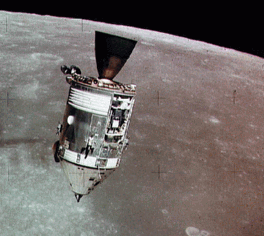
The Apollo 15 and 16 missions were launched on 26 July 1971 and 16 April 1972, respectively. Splashdowns were 7 August 1971 and 27 April 1972. Both released sub-satellites while in orbit around the Moon to do studies on lunar gravity and magnetic fields. Apollo 16 astronauts John Young and Charles Duke deployed a UV electrographic camera/spectrograph on the lunar surface. The instrument observed the Sun, the Earth’s geocorona and various astronomical objects. Both Apollo 15 & 16 Command Service Modules carried gamma-ray spectrometers. These spectrometers studied the Moon and the gamma-ray background.
Both Apollo command modules carried a 512-channel cylindrical NaI(Tl) scintillation gamma-ray spectrometer, 76x76 mm in size, covered with a plastic scintillator for charged particle rejection. The instrument was mounted on a 7.6 m boom.
Gamma Ray Spectrometer
Energy Range
0.55–8.6 MeV
Energy Resolution
8%
Both Apollo command modules carried a 512-channel cylindrical NaI(Tl) scintillation gamma-ray spectrometer, 76x76 mm in size, covered with a plastic scintillator for charged particle rejection. The instrument was mounted on a 7.6 m boom.
Science Highlights
Though primarily intended to study the Moon’s radioactivity, it found a cosmic gamma-ray background flux density of ∼1 x 10⁴ quanta/m2/s during the mission flights.