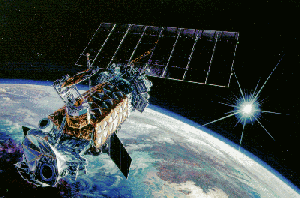
Defense Meteorological Satellites Program (DMSP) series
The Defense Meteorological Satellites Program (DMSP) has been run by the US Air Force since the mid-1960s. They have launched a series of spacecraft to investigate the Earth’s environment from an altitude of ∼800 km. They were all put into Sun-synchronous near-polar orbits (inclination ∼99°). The missions of interest to the high-energy science community are DMSPs 8–15.
Mission Characteristics
Lifetime
20 Jun 1987–1 Aug 1994 (DMSP 8)
3 Feb 1988–3 Apr 1992 (DMSP 9)
1 Dec 1990–26 Sep 1994 (DMSP 10)
6 Dec 1991–7 Aug 2000 (DMSP 11)
8 Sep 1994–2008 (DMSP 12)
24 Mar 1995–3 Feb 2015 (DMSP 13)
4 Apr 1997–11 Feb 2020 (DMPS 14)
24 Jan 2000–Dec 2020 (DMSP 15)
Special Features
In addition to remote sensing data for meteorology, several satellites in the series carried gamma-ray burst detectors
Lifetime
20 Jun 1987–1 Aug 1994 (DMSP 8)
3 Feb 1988–3 Apr 1992 (DMSP 9)
1 Dec 1990–26 Sep 1994 (DMSP 10)
6 Dec 1991–7 Aug 2000 (DMSP 11)
8 Sep 1994–2008 (DMSP 12)
24 Mar 1995–3 Feb 2015 (DMSP 13)
4 Apr 1997–11 Feb 2020 (DMPS 14)
24 Jan 2000–Dec 2020 (DMSP 15)
Special Features
In addition to remote sensing data for meteorology, several satellites in the series carried gamma-ray burst detectors
Payload
Instrument
Details
Gamma Ray Detectors
Each satellite carried a pair of gamma-ray detectors, each with ∼100 cm2 detection area NaI crystal detectors equipped with charged particle shields. Passing through the outer Van Allen belts 4 times each orbit, and often through the South Atlantic Anomaly, led to a very high background. However, there were still long periods in each orbit during which cosmic gamma-rays could be detected.
Gamma Ray Detectors
Each satellite carried a pair of gamma-ray detectors, each with ∼100 cm2 detection area NaI crystal detectors equipped with charged particle shields. Passing through the outer Van Allen belts 4 times each orbit, and often through the South Atlantic Anomaly, led to a very high background. However, there were still long periods in each orbit during which cosmic gamma-rays could be detected.
Science Highlights
Participation in the Interplanetary gamma-ray burst Network (IPN3). Several bursts were recorded by DMSP sensors as part of the network