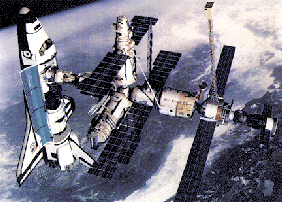
The Kvant (“Quantum” in Russian) 1 module was launched on 31 March 1987 and attached to the Mir Space Station on 12 April 1987. After that, the Mir-Kvant observatory successfully operated until fall 1989, at which time operation was stopped for a planned reconfiguration of the Mir station. Kvant was restarted in October 1990 with calibration observations showing no apparent degradation in performance from the year off.
The orbital period of the Mir station was 90 minutes. At an inclination of 57 degrees, of which 20 minutes of each orbit of each orbit were spent outside the radiation belts. The spacecraft stabilization over a 20 minute period was been better than 2 arcminutes. The Kvant module was 19 feet long and 13.6 feet across at its widest point. A cosmonaut controls the observations from a pressurized cabin inside the module.
The module continued with astronomical observations throughout the 1990s, including restoration work on the primary processing unit in 1998. The last citation of Kvant observational data is from roughly this time: the last crew departed Mir in 1999, and the space station itself was de-orbited in 2001
Mission Characteristics
Lifetime
Apr 1987–late 1989; Oct 1990–1998
Special Features
X-ray telescope facility attached to Mir Space Station
Lifetime
Apr 1987–late 1989; Oct 1990–1998
Special Features
X-ray telescope facility attached to Mir Space Station
Payload
Instrument
Characteristic
Details
Coded Mask Images Spectrometer (TTM/COMIS)
Energy Range
2–30 keV
Effective Area
655 cm2
Field of View
15° × 15 ° (FWHM)
Angular Resolution
2′
Energy Resolution
18–20% at 6 keV
Time Resolution
1 s
A wide field X-ray telescope camera with a coded mask at the entrance aperture to deter the position of sources
High Energy X-ray Experiment (HEXE)
Energy Range
15–200 keV
Effective Area
200 cm2 each 800 cm2 total
Field of View
1.6° × 1.6° (FWHM)
Time Resolution
0.2–25 ms
HEXE was an X-ray spectrometer consisting of four identical phoswich detectors with a swinging collimator which turns every two minutes to measure the X-ray background. The phoswich employed sodium iodide and cesium iodide as detection mediums.
Gas Scintillation Proportional Counter (GSPC)
Energy Range
2–100 keV
Effective Area
300 cm2
Field of View
3° × 3° (FWHM)
Time Resolution
1.25–2.5 ms
Also known as Sirene 2
Pulsar X-1
Energy Range
50–800 keV
Effective Area
314 cm2 each
Field of View
3° × 3° (FWHM)
Time Resolution
10 s
Pulsar X-1 consisted of four identical phoswich detectors
Coded Mask Images Spectrometer (TTM/COMIS)
Energy Range
2–30 keV
Effective Area
655 cm2
Field of View
15° × 15 ° (FWHM)
Angular Resolution
2′
Energy Resolution
18–20% at 6 keV
Time Resolution
1 s
A wide field X-ray telescope camera with a coded mask at the entrance aperture to deter the position of sources
High Energy X-ray Experiment (HEXE)
Energy Range
15–200 keV
Effective Area
200 cm2 each 800 cm2 total
Field of View
1.6° × 1.6° (FWHM)
Time Resolution
0.2–25 ms
HEXE was an X-ray spectrometer consisting of four identical phoswich detectors with a swinging collimator which turns every two minutes to measure the X-ray background. The phoswich employed sodium iodide and cesium iodide as detection mediums.
Gas Scintillation Proportional Counter (GSPC)
Energy Range
2–100 keV
Effective Area
300 cm2
Field of View
3° × 3° (FWHM)
Time Resolution
1.25–2.5 ms
Also known as Sirene 2
Pulsar X-1
Energy Range
50–800 keV
Effective Area
314 cm2 each
Field of View
3° × 3° (FWHM)
Time Resolution
10 s
Pulsar X-1 consisted of four identical phoswich detectors
Science Highlights
1000+ observation sessions of known X-ray sources (Her X-1, Cyg X-1, Cen A, etc.)
Galactic center region images with TMM/COMIS demonstrated the efficiency of coded mask telescope observations in hard X-rays
Catalog of 67 known bursts detected by TTM/COMIS plus hard X-ray spectra from HEXE