
Come analyze HEASARC, IRSA, and MAST data in the cloud! The Fornax Initiative is now welcoming all interested beta users.


Minisat-1 (LEGRI)


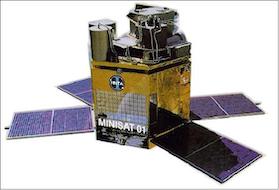
Minisat-1

The Minisat-1 mission was a Spanish-led mission with a primary instrument being the Low Energy Gamma-ray Imager (LEGRI), a coded masked prototype instrument. The satellite was launched on April 21, 1997 from a Pegasus XL rocket (a “winged” rocket dropped from an aircraft) and the LEGRI instrument onboard was activated on May 19, 1997. The instrument was a collaboration between the University of Valencia, University of Alicante, Centro de Investigaciones Energeticas, Medioambientales y Technologicas (CIEMAT), Instituto Nacional de Technica Aerospacial (INTA), University of Southampton, University of Birmingham, and the Rutherford Appleton Laboratory.

Minisat-1 was the first operational mission in the Minisat series. It was planned with a two year mission span, but ultimately operated successfully for five years before re-entry into the Earth’s atmosphere. LEGRI was not the only instrument on MiniSat-1, but is the primary one of interest to high-energy astrophysics.

Mission Characteristics

Lifetime
19 May 1997–2002
Special Features
Proof of concept for coded mask gamma-ray detectors

Payload

Low Energy Gamma-ray Imager (LEGRI)

Energy Range
10–200 keV
Effective Area
∼6 cm2 at 30 keV
∼3 cm2 at 100 keV
Field of View
∼11° (fully coded)
∼24° (partial coded)
Angular Resolution
20′
Energy Resolution
4 keV at 30 keV (FWHM)
LEGRI was a coded mask array gamma ray detector. The detector plane was a mosaic of 10 × 10 with 80 HgI2 and 20 CdZnTe crystals 0.5 cm thick: the mixed detectors were intended to test differing technologies under identical conditions. The detector was passively shielded on the back and sides by the mechanical assembly and by a tantalum collimator and aluminum window in the pointing direction. The coded mask was mounted 540 mm in front of the instrument and was made of tungsten elements attached to a honeycomb plate and support structure. A start sensor allowed precise tracking of attitude of the spacecraft to permit ground-based analysis without blurring from spacecraft motion.

Science Highlights

LEGRI was primarily a proof-of-concept mission for coded-mask gamma-ray imaging. Having shown the concept worked, LEGRI detected and characterized gamma-ray burst sources in particular.