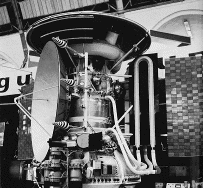
Mars 4 was launched by the USSR on 21 July 1973 and its twin, Mars 5, was launched 4 days later on 25 July. As Mars 4 approached the red planet on 10 February 1974, its retro-engine malfunctioned, placing it into a heliocentric orbit. However, in February 1974, the Mars 5 probe was put successfully into orbit around Mars, with apoapsis 32,560 km, periapsis 1760 km. The inclination of the orbit to the equator of the planet was 35 dgrees;. It took 24 hours 53 minutes to complete one orbit. Both probes contained identical sets of instruments intended to investigate the composition, structure, and properties of the Martian atmosphere and surface.
Mission Characteristics
Lifetime
Jul 1973–early 1974
Special Features
Gamma-ray spectrometers for measuring geological composition of Martian surface
Lifetime
Jul 1973–early 1974
Special Features
Gamma-ray spectrometers for measuring geological composition of Martian surface
Payload
Instrument
Characteristic
Details
Gamma-ray spectrometer
Energy Range
1–9 MeV
Mars 4 & 5 both contained a 256-channel NaI scintillation gamma-ray spectrometer which was 63 × 63 mm, with charged particle rejection. The instrument was located on a boom away from the spacecraft body to reduce background noise. Its primary objective was to measure the spectral composition of Mars’ gamma-radiation. However, a series of measurements of the cosmic gamma-ray background were made during the flight from Earth to Mars.
Gamma-ray spectrometer
Energy Range
1–9 MeV
Mars 4 & 5 both contained a 256-channel NaI scintillation gamma-ray spectrometer which was 63 × 63 mm, with charged particle rejection. The instrument was located on a boom away from the spacecraft body to reduce background noise. Its primary objective was to measure the spectral composition of Mars’ gamma-radiation. However, a series of measurements of the cosmic gamma-ray background were made during the flight from Earth to Mars.
Science Highlights
A series of measurements of the cosmic gamma-ray background were made during the flight from Earth to Mars. Six measurements sessions were performed at 61.2, 85.4, and 93.8 million miles from Earth. The Mars 4 & 5 gamma-ray spectrometers found an average cosmic gamma-radiation background flux density of 1.85 × 10⁻⁴ quanta/m2/s
Mars 5 went on to be a great success in its primary studies of Mars, completing 22 orbits of the planet while collecting and transmitting data until 28 Feb 1974, when its transmitter failed.