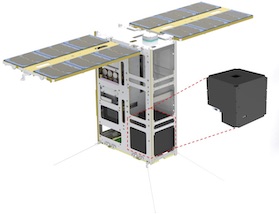
The Polarimeter Light (PolarLight) mission was a technology demonstration instrument on-board a CubeSat named Tongchuan-1 (or Zhaojin 1 (TY 4–02)). It used a gas pixel detector sensitive to polarized X-ray light. The satellite was launched into a sun synchronous polar orbit on October 28, 2018. The mission was led by the China Center for Astrophysics at Tsinghua University in Beijing, China.
The satellite reentered the Earth’s atmosphere in early January 2025.
Mission Characteristics
Lifetime
Oct 2018–Jan 2025
Lifetime
Oct 2018–Jan 2025
Payload
Instrument
Characteristic
Details
Gas Pixel Detector (GPD)
Energy Range
2–8 keV
Effective Area
1.64 mm2 (1.4×1.4 mm)
Field of View
∼2.3° (FWHM)
Energy Resolution
∼16% E/ΔE at 6 keV (FWHM)
Time Resolution
1µs
The GPD instrument was filled with dimethyl ether at approximately 0.8 atmosphere pressure, and sealed with a 100 micron thick beryllium window. It used a capillary plate collimator made of lead glass. The detector was mounted on a 6U size Cubesat for supporting electronics, power supply, data recording, and solar panels.
Gas Pixel Detector (GPD)
Energy Range
2–8 keV
Effective Area
1.64 mm2 (1.4×1.4 mm)
Field of View
∼2.3° (FWHM)
Energy Resolution
∼16% E/ΔE at 6 keV (FWHM)
Time Resolution
1µs
The GPD instrument was filled with dimethyl ether at approximately 0.8 atmosphere pressure, and sealed with a 100 micron thick beryllium window. It used a capillary plate collimator made of lead glass. The detector was mounted on a 6U size Cubesat for supporting electronics, power supply, data recording, and solar panels.
Science Highlights
The GPD instrument produced preliminary results from observations of the Crab and Sco X-1 sources.