Time Resolution
10 ms within channels
128 ms over all channels
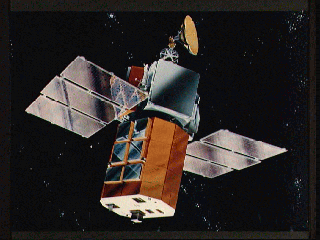
The primary objective of HXRBS was to study hard X-ray spectra of solar flares on time scales as short as 10 ms. The Principal Investigator was K. Frost. The HXRBS instrument could also be used for observing the hard X-ray spectra of gamma-ray bursts which fell within the field of view of the detector. The HXRBS detector consisted of a CsI(Na) scintillator with a radius of 4.67 cm and thickness of 0.64 cm. The crystal was surrounded on all sides (except for the solar direction) by a CsI(Na) shield of thickness 3.2 cm. Events were pulse height analyzed in 15 channel energy spectra from 30–500 keV. The time resolution was 128 ms. However, the total count rate over the same energy ranges was recorded every 10 ms. The HXRBS threshold for detecting a gamma-ray burst was 1 × 10⁻⁷ ergs/cm2 (E > 30 keV). Since the SMM views the Earth during the nighttime portion of each orbit, only about 1 event on 40 is detected with a π/6 sr field of view for which the spectra are not badly contaminated by the shield-processed contributions. Between launch and mid-1985, more than 15 gamma-ray bursts were seen by the HXRBS.