|
The Einstein (HEAO-2) FPCS Instrument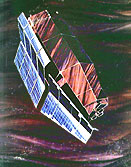 Most of the 389 FPCS observations were designed to search for specific
spectral features: lines, absorption edges, and recombination
edges. There were about 40 aperture-map observations of the strong
point sources Cyg X-1, Cyg X-2, and Sco X-1, whose purpose was to
determine, in flight, the position of the aperture relative to the
spacecraft pointing direction. This information is particularly
relevant to the detailed analysis of data from extended sources (i.e.,
supernova remnants and clusters of galaxies, etc.). Finally, there
were three spectral surveys of compact objects, the purpose of which
was to combine a large number of individual observations, made at
about the same time, in order to obtain the equivalent of a fairly
large spectral scan. The three sources surveyed were AM Her and Her
X-1 on the range ~200-300 eV and Sco X-1 in the range ~700-1200 eV.
Most of the 389 FPCS observations were designed to search for specific
spectral features: lines, absorption edges, and recombination
edges. There were about 40 aperture-map observations of the strong
point sources Cyg X-1, Cyg X-2, and Sco X-1, whose purpose was to
determine, in flight, the position of the aperture relative to the
spacecraft pointing direction. This information is particularly
relevant to the detailed analysis of data from extended sources (i.e.,
supernova remnants and clusters of galaxies, etc.). Finally, there
were three spectral surveys of compact objects, the purpose of which
was to combine a large number of individual observations, made at
about the same time, in order to obtain the equivalent of a fairly
large spectral scan. The three sources surveyed were AM Her and Her
X-1 on the range ~200-300 eV and Sco X-1 in the range ~700-1200 eV.The procedure used to analyze FPCS data can be summarized as follows. Timing, pulse-height, and position discrimination are used to remove much of the background. The residual background is then determined and subtracted, yielding the net signal from the source. Finally, the incident flux is determined by taking into account the known efficency of the instrument.
Page authors: Lorella Angelini Jesse Allen HEASARC Home | Observatories | Archive | Calibration | Software | Tools | Students/Teachers/Public Last modified: Thursday, 24-Sep-2020 19:05:13 EDT |


 High Level Data Products: These data files were produced
at MIT in FITS format. Data from this instrument are also available
on the HEASARC
High Level Data Products: These data files were produced
at MIT in FITS format. Data from this instrument are also available
on the HEASARC