
Come analyze HEASARC, IRSA, and MAST data in the cloud! The Fornax Initiative is now welcoming all interested beta users.


ISEE-3/ICE


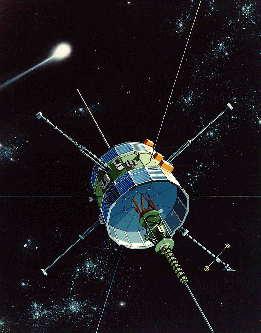
artist concept of ISEE-3 approaching a comet

The International Sun-Earth Explorer (ISEE) program consisted of 3 satellites — ISEE-1 and ISEE-3 were the principal US contribution to the International Magnetospheric Study, and ISEE-2 which was built and managed by ESA. ISEE-1 and -2 were launched on 22 October 1977 into almost coincident orbits. The orbital period was 57 hours, and their separation in the orbit was controlled by maneuvering ISEE-2. ISEE-3 was launched on 12 August 1978. It was inserted into a “halo” orbit about the libration point some 240 Earth radii upstream between the Earth and Sun. ISEE-3 was renamed ICE (International Cometary Explorer) when, after completing its original mission in 1982, it was gravitationally maneuvered to intercept the comet P/Giacobini-Zinner. On September 11, 1985, the veteran NASA spacecraft flew through the tail of the comet.

NASA formally discontinued operations in May 1997, with no more than a carrier signal left active for tracking. In 2014, ISEE’s orbit again brought it near the Earth-Moon system and the “ISEE-3 Reboot Project” successfully re-established two-way communication. An initial thruster firing on July 2, 2014 was successful (after 27 years in statis), but a longer duration burn on July 8 did not succeed, likely due to depletion of the nitrogen pressurant in the fuel system. Further attempts to command the spacecraft failed, with all contact lost in September 2014.

Mission Characteristics

Lifetime
Oct 1977–May 1997
Special Features
  • Initial orbital location at the Earth-Sun L1 Lagrange point — the first spacecraft to operate in that location
  • First satellite to fly by a comet (Giacobini-Zinner in 1985)
  • Years of stable low background measurements from deep space

Payload

X-ray Spectrometer

Energy Range
5–1250 keV
Field of View
3π sr (E > 130 keV)
Time Resolution
0.25 ms (1 ms absolute)
The X-ray spectrometer was designed to study both solar flares and cosmic gamma-ray bursts. The detector was intended to be a part of a long baseline interferometry network of widely separated spacecraft. The efforts were aimed primarily at determining the origin of the bursts through precise directional information established by such a network. The experiment consisted of 2 cylindrical X-ray detectors: a Xenon filled proportional counter covering 5–14 keV, and a NaI(Tl) scintillator covering 12–1250 keV. The proportional counter was 1.27 cm in diameter and was filled with a mixture of 97% Xenon and 3% carbon dioxide. The central part of the counter body was made of 0.51 mm thick beryllium and served as the X-ray entrance window. The scintillator consisted of a 1.0 cm thick cylindrical shell of NaI(Tl) crystal surrounded on all sides by 0.3 cm thick plastic scintillator. The central region, 4.1 cm in diameter, was filled by a quartz light pipe. The whole assembly was enclosed (except for one end) in a 0.1 cm thick beryllium container. The energy channel resolution and timing resolution could be selected by commands sent to the spacecraft. The proportional counter could have up to 9 channels with 0.5 s resolution; the NaI scintillator could have up to 16 channels and 0.00025 s resolution. The gamma-ray burst mode was triggered by two simultaneous conditions: the count rates in certain PHA channels rose above a selected level and the spectral hardness of incident photons as determined by the ratio of 2 selected PHA channels exceeded a certain value.

Goddard Gamma Ray Burst Spectrometer

Energy Range
200 keV – 3 MeV
Energy Resolution
10 keV at 570 keV; 4096 energy channels total
Time Resolution
8 ms
The germanium detector was a high purity 4.02 × 2.9 cm right circular cylinder. The total germanium volume was 35 cu-cm. The detector was hermetically sealed in a Mg enclosure, which also provided the radiative surface for cooling. This structure reached a temperature of 130K roughly 3 days after launch and remained stable at that value for over a year. The detector system had a resolution of 10 keV at 570 keV and had 4096 energy channels.

Science Highlights

  • Component of the Interplanetary Gamma Ray Burst Network (IPN)
  • Demonstrated direct links between solar flare X-rays and interplanetary effects