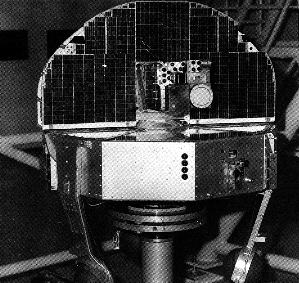
The Third Orbiting Solar Observatory (OSO-3), was launched on 8 March 1967, into a nearly circular orbit of mean altitude 550 km, inclined at 33 degrees with respect to the equatorial plane. The satellite had two principle components, a continuously spinning wheel in which the hard X-ray experiment is mounted with a radial view, and a sail component which was served to acquire the sun during the orbit day. The attitude control system maintained the scan plane orientation to within a few degrees of the sun. The spin-period of the satellite of roughly 1.7 s allowed about 1 cm2/s exposure per revolution to sources on the scan plane. Celestial sources near the ecliptic plane such as Sco X-1 transited the instrument scan plane twice a year. Only real-time data were received from the satellite after the last tape recorder failure on 27 June 1968. The last data transmission occurred 10 November 1969. OSO-3 descended into the atmosphere on 4 April 1982.
Mission Characteristics
Lifetime
Mar 1967–10 Nov 1969
Lifetime
Mar 1967–10 Nov 1969
Payload
Instrument
Characteristic
Details
USCD X-ray Telescope
Energy Range
7.7–210 keV
Effective Area
10 cm2
Field of View
23°
Energy Resolution
45% at 30 keV (6 channel resolution)
The UCSD X-ray telescope consisted of a single thin NaI(Tl) scintillation crystal plus phototube assembly enclosed in a howitzer-shaped CsI(Tl) anti-coincidence shield. It scanned the entire sky over the course of the mission.
MIT Gamma Ray Instrument
Energy Range
> 50 MeV
The MIT Gamma Ray Instrument operated continuously for about 16 months, at which time the last spacecraft tape recorded failed. The detector was a counter telescope. The multi-layer scintillation detector consisted of layers of CsI and plastic. The directional Cerenkov counter was a 3 × 3 in cylinder of lucite. The energy detector contained several layers of NaI, sandwiched by layers of tungsten. The entire detector was enclosed by plastic scintillator detectors.
USCD X-ray Telescope
Energy Range
7.7–210 keV
Effective Area
10 cm2
Field of View
23°
Energy Resolution
45% at 30 keV (6 channel resolution)
The UCSD X-ray telescope consisted of a single thin NaI(Tl) scintillation crystal plus phototube assembly enclosed in a howitzer-shaped CsI(Tl) anti-coincidence shield. It scanned the entire sky over the course of the mission.
MIT Gamma Ray Instrument
Energy Range
> 50 MeV
The MIT Gamma Ray Instrument operated continuously for about 16 months, at which time the last spacecraft tape recorded failed. The detector was a counter telescope. The multi-layer scintillation detector consisted of layers of CsI and plastic. The directional Cerenkov counter was a 3 × 3 in cylinder of lucite. The energy detector contained several layers of NaI, sandwiched by layers of tungsten. The entire detector was enclosed by plastic scintillator detectors.
Science Highlights
The instrument flown on OSO-3 obtained extensive observations of solar flares, the diffuse component of cosmic X-rays, and the observation of a single flare episode from Sco X-1.
The gamma-ray instrument registered 621 events attributed to cosmic gamma rays above 50 MeV. A complete sky survey showed that the celestial distribution of gamma rays is highly anisotropic, being concentrated along the galactic equator. In addition, an extended region around the galactic center showed a higher measured intensity.