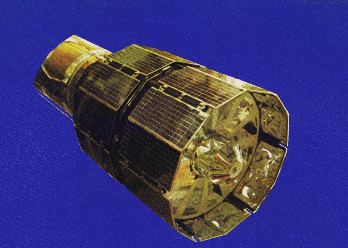
The ESRO-2B mission was launched on 17 May 1968, with an elliptical orbit with an initial apogee 1086 km, perigee 326 km, and inclination 97.2 degrees. The orbital period was 98.9 minutes. It was the first successful ESRO satellite launch. ESRO (European Space Research Organization), was the forerunner of ESA. ESRO-2B was also known as Iris. The satellite was mainly intended to study X-ray and particle emissions from the Sun, however, it is credited with some extra-solar observations. The spacecraft was cylindrical in shape, with a 0.76 m diameter and a 0.85 m height. It weighed 80 kg. The failure of the on-board tape recorder in December 1968 (after roughly 6.5 months of operation) was catastrophic for the 2 X-ray experiments. They did not provide any significant data return after that time. The satellite reentered the atmosphere on 8 May 1971.
Mission Characteristics
Lifetime
May–Dec 1968
Special Features
The satellite carried seven instruments to detect high energy cosmic rays, determine the total flux of solar X-rays, and measure trapped radiation, Van Allen belt protons and cosmic ray protons. While geared primarily for solar observations, the detectors are credited with the detection of non-solar X-ray sources.
Lifetime
May–Dec 1968
Special Features
The satellite carried seven instruments to detect high energy cosmic rays, determine the total flux of solar X-rays, and measure trapped radiation, Van Allen belt protons and cosmic ray protons. While geared primarily for solar observations, the detectors are credited with the detection of non-solar X-ray sources.
Payload
Instrument
Characteristic
Details
S25
Time variations on radiation belt population
S27
Energy Range
1–100 MeV (protons)
Solar and radiation belt protons and alpha particles
S28
Energy Range
0.4–0.8 GeV
High-energy solar protons and alpha particles
S29
Energy Range
1–13 GeV
Flux and energy spectrum of primary electrons
S36
Wavelength
1–20 Å
Solar X-ray detector with proportional counters with varying window thickness
S37
Wavelength
44–60 Å
Solar X-ray detector with proportional counters with thin mylar windows
The satellite carried seven instruments to detect high energy cosmic rays, determine the total flux of solar X-rays, and measure trapped radiation, Van Allen belt protons and cosmic ray protons. There were 2 X-ray instruments: one designed to detect 1–20 Angstroms (consisting of proportional counters with varying window thickness) and one designed to detect 44–60 Angstroms (consisting of proportional counters with thin mylar windows). While geared primarily for solar observations, the detectors are credited with the detection of non-solar X-ray sources.